
The Michigan Public Records Framework
Michigan splits public access into two tracks. Executive and local-government records run under the Michigan Freedom of Information Act, MCL 15.231 and the sections that follow. Court case files run under Michigan Court Rule 8.119. The two tracks share a goal. The two tracks use different forms.
The FOIA side covers most county business. A Kalamazoo Sheriff incident report is a FOIA record. A prosecutor's policy file is a FOIA record. A County Clerk administrative document is a FOIA record. The court rule side covers a different layer. A judge's case file, a docket sheet, a sentencing order, and a divorce judgment all sit in the court clerk's hands under MCR 8.119, not FOIA. The split matters because the wrong route can mean a denial or a long delay.
Some offices wear two hats. The Kalamazoo County Clerk is one of them. The Clerk holds vital records, deeds, and county business filings on the administrative side. The same office also serves as clerk to the 9th Circuit Court for case files on the court-rule side. A user must know which hat fits the request. A marriage license copy uses the clerk path. A felony case docket uses the court path.
Search Kalamazoo County public records by picking the agency first, then the legal route. The agency dictates the rules. The rules dictate the form, the fee, and the deadline.
Note: The Michigan FOIA framework runs from MCL 15.231 through MCL 15.243. Key sections include 15.233 on inspection rights, 15.234 on fees, 15.235 on response timelines, and 15.240 on appeals and civil action.
What Kalamazoo Public Records Cover
Public records in Kalamazoo County fall into four broad groups. Court records form the first group. These are case files held by the 9th Circuit Court, the 8th District Court, and the Probate Court. They include civil complaints, criminal dockets, motions, orders, judgments, hearing notices, and sentence sheets. Public access for court files is broad. Sealed, juvenile, adoption, mental-health, and expunged records stay closed.
Sheriff and law-enforcement records form the second group. These are held by the Kalamazoo County Sheriff and other police agencies. Incident reports, arrest logs, jail booking data, and 911 calls fall here. Some files stay closed while a case is open. Body-cam and dash-cam footage may need a fee and a redaction pass. The Kalamazoo County Prosecutor holds charging files and case-decision memos that may be exempt while a matter is open.
County Clerk records form the third group. The Kalamazoo County Clerk holds vital records, deeds, mortgages, liens, county business filings, election files, and assumed-name records. Vital records have their own access rules. A birth record stays closed for many years. A death record opens sooner. A marriage license is more open.
Administrative county records form the last group. Budgets, contracts, meeting minutes, policy manuals, internal correspondence, and personnel data sit here. Most are open. Some stay closed by exemption.
- Court case files: dockets, motions, orders, judgments, sentences
- Law-enforcement files: incident reports, arrest logs, jail data, certain video
- Clerk records: vital records, deeds, business filings, election files
- Administrative county files: budgets, contracts, minutes, policies
How to File a Kalamazoo Public Records Request
A FOIA request in Michigan starts in writing. The request must describe the records well enough for the agency to find them. Vague asks get bounced. Clear asks get answers. The county runs a central Record Requests page that lists routes for many county offices. Court records use a different form, such as the District Court Court Record Copy Request Form.
Follow these steps:
- Identify the right agency. Pick the office that holds the file. Sheriff for police reports. Prosecutor for charging memos. Clerk for vital records and deeds. Court clerk for case files. Guessing the wrong office leads to a denial or a slow forward.
- Describe the records with care. List the file type, date range, party names, case number, incident number, or address. The more facts, the faster the search. Skip broad phrases like "all records about me." That style of ask is hard to fulfill.
- Send a written request. Mail, fax, or email work for FOIA. Many offices accept a web form. Keep a copy with a date stamp. Use a delivery method that proves the agency got it.
- Expect a statutory response. Michigan gives the public body a set time to act. The office may grant, deny, partly grant, or extend. A reply must come back in writing under MCL 15.235.
- Get the records or a denial with a stated reason. Pay any fee due. A denial must cite a legal ground. A partial release must list what was held back. If the answer is no, the next step is an appeal or a court action.
A request to a court office uses a court form, not a FOIA letter. The County Clerk office and the 8th District Court each post their own forms. The 9th Circuit Court files flow through the same clerk that handles county-level business filings.
The Michigan FOIA declaration of public policy at MCL 15.231 sets out the open-access goal that drives every county FOIA response.
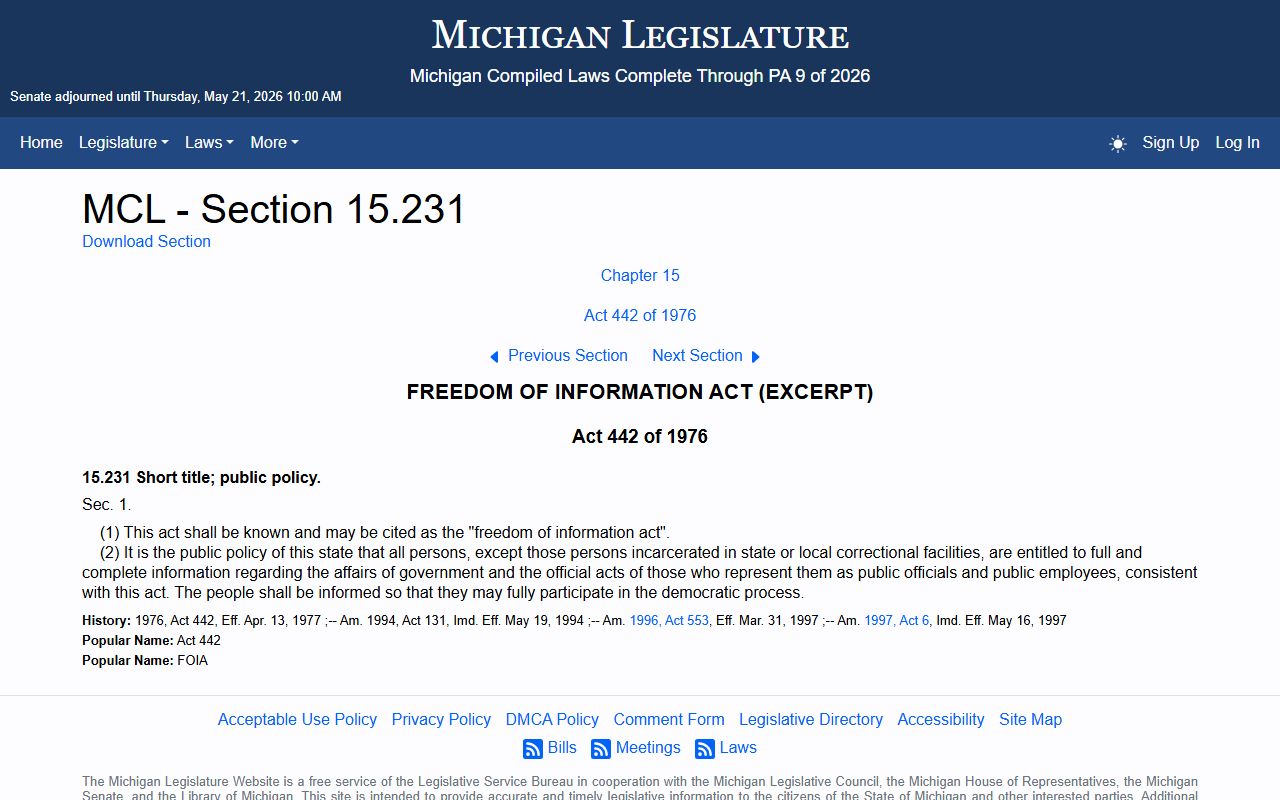
The statute frames the public's right to know. The sections that follow set out the actual rules.
Public Records Request Form Fields
A FOIA request does not need a special form, but most public bodies ask for the same data points. The table below shows the core fields a generic Michigan FOIA letter or web form should hold.
| Field | Required | Notes |
|---|---|---|
| Requestor name | Yes | Full legal name. Some bodies ask for media or commercial status. |
| Contact information | Yes | Mail address, phone, and email. Used for the response and any fee notice. |
| Records sought (description) | Yes | Be precise. List file type, case or report number, party names, and topic. |
| Date range | Preferred | A narrow date band cuts labor cost and speeds the search. |
| Format preference | Optional | Paper, PDF, email, USB. The agency may offer fewer formats. |
| Fee acknowledgment | Yes | State a fee cap or ask for a written estimate first. |
| Fee waiver request | Optional | Indigence and public-interest waivers may apply under MCL 15.234. |
| Signature and date | Yes | Required on paper. A typed name works on email or web forms. |
Fees for Kalamazoo Public Records
Michigan FOIA fees follow the rules in MCL 15.234. A public body may charge for labor, duplication, and mail cost. The labor rate is tied to the wage of the lowest-paid person who can do the task. The duplication rate is tied to the real per-page cost. Mail charges are billed at actual cost. A body must use an itemized fee form. A body may ask for a deposit when the estimate runs over a set figure.
Each Kalamazoo office sets its own fees inside the state rules. The Sheriff, Prosecutor, and County Clerk each post fee notes on their own pages. Court fees follow a separate court-rule schedule, not FOIA.
| Fee Category | What It Covers | Notes |
|---|---|---|
| Labor (search) | Time to locate and pull records | Tied to lowest-paid able worker. Verify on agency response. |
| Labor (review and redaction) | Time to review and black out exempt content | Same wage rule. Itemized on the fee notice. |
| Duplication (per page) | Paper copies of records | Capped at actual cost. Verify on agency response. |
| Electronic media | USB, disc, or large email transfer | Actual cost of the medium. Email may be free. |
| Mailing | Postage and packaging | Actual cost. Pickup is free. |
| Fee waiver | Indigence or public interest | First $20 may be waived for sworn indigence. Verify on agency response. |
| Deposit | Up-front payment on large requests | Allowed when estimated fee passes the statutory line. |
A user who wants firm numbers should ask for a written fee estimate before the office runs the full search. That step locks in scope and cost.
The FOIA fee statute at MCL 15.234 lays out the labor, copy, and mail rules every Michigan public body must follow.
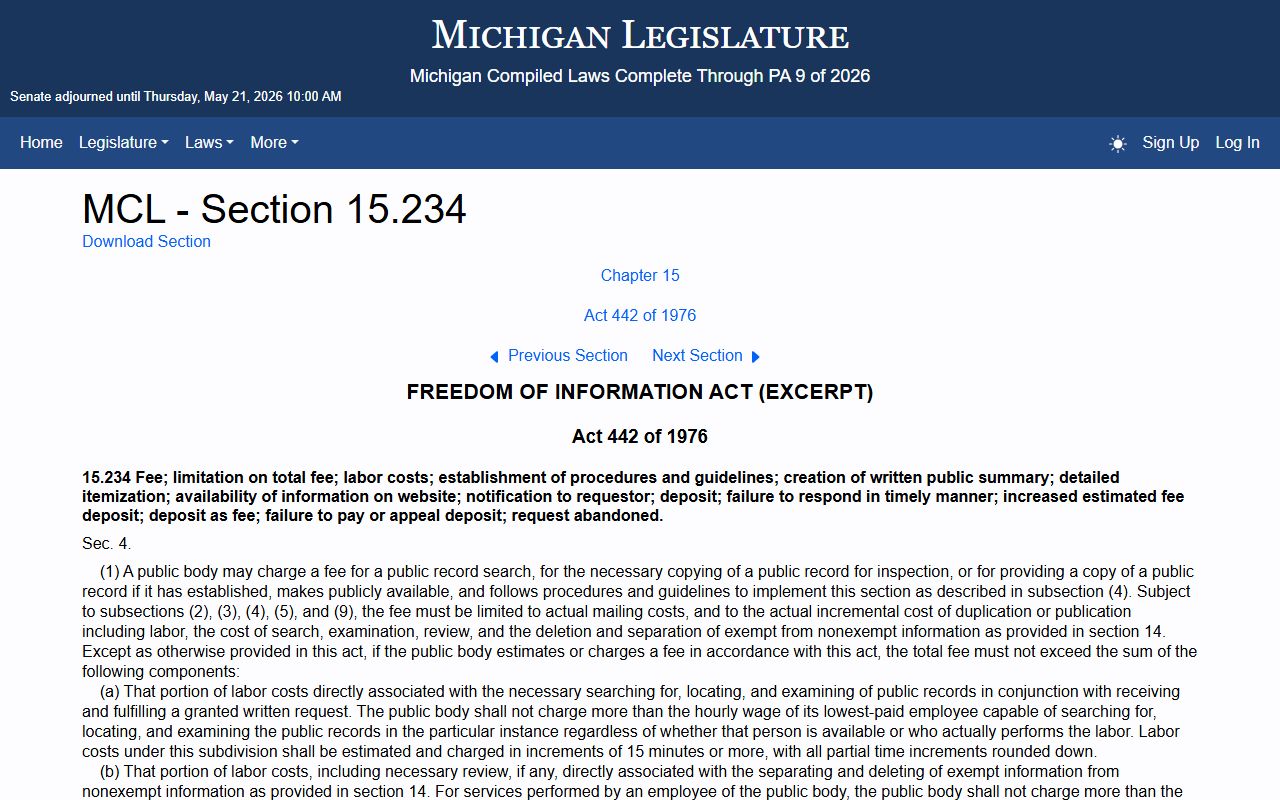
Read the section before you accept a fee notice. It limits what an office can charge.
Response Timelines and Denials
Michigan FOIA sets clear deadlines. MCL 15.235 says a public body must answer in writing within a short statutory window. The office may grant the request, deny it, grant part and deny part, or take a one-time extension. A failure to answer counts as a denial.
A grant in full sends the records, with the fee notice. A partial grant sends what is open and lists what is held back. A denial must say which exemption applies and must cite the law. A blanket denial without a reason does not meet the statute. The reply must also tell the requester how to appeal.
An extension buys the agency more time, but only once per request and only for a stated reason. The notice must give a new date. A second extension is not allowed under the same request.
Common Exemptions
Not every record is open. Michigan lists exemptions in MCL 15.243. The list is long, but a few core categories cover most denials in Kalamazoo:
- Personal privacy: home address, medical data, family detail, and similar private items.
- Law-enforcement investigation: open cases, informant data, and methods that would harm the case if released.
- Public safety and security: building plans, alarm codes, and infrastructure data.
- Attorney-client and work-product: legal advice and litigation files held by counsel.
- Records made confidential by other laws: juvenile, adoption, mental-health, sealed, expunged, and protected health files.
- Personnel files: parts may stay closed while parts release with redaction.
- Frank-communication and trade-secret content: limited categories with strict tests.
An exemption is not a free pass. The office must prove the record fits the cited rule. A court can review that call.
Appeals and Civil Action
A denial is not the end of the road. MCL 15.240 gives a requester two main paths. The first path is an internal appeal. The user sends a written appeal to the head of the public body. The head must then review the call and answer within a set time. A reverse means the records come out. A second denial sets up the next step.
The second path is a civil action. The requester may file suit in the Michigan circuit court for the county that holds the record. The court can order the records out, can award attorney fees, and can award damages when the denial was willful. The court can also order a punitive fine in some cases. The civil-action route is strong, but it takes time, filing fees, and often legal help.
Fee disputes follow a similar split. A user can appeal the fee to the head of the body or to circuit court. The judge may cut the fee or strike it.
Court Records vs FOIA Requests
This split trips up many requesters. A court case file is not a FOIA record. A FOIA letter sent to the court clerk for a case file does not work. The clerk uses Michigan Court Rule 8.119 and the court's own forms. The County Clerk and the District Court each respond to the records they hold, but each uses its own rules for each kind of file.
| Aspect | FOIA Request | Court Records Request |
|---|---|---|
| Legal basis | MCL 15.231 et seq. | MCR 8.119 and related court rules |
| Who responds | Sheriff, Prosecutor, Clerk (administrative), county departments | Court clerks: 9th Circuit, 8th District, Probate |
| Form used | FOIA letter, agency web form, or central record request portal | Court record copy form or in-person clerk request |
| Fees | Labor, copy, mail; capped by MCL 15.234 | Statutory court fees; certified copy fee per court |
| Timeline | Statutory response window under MCL 15.235 | Court-clerk processing time; no fixed FOIA clock |
| Appeals | Head of body or circuit-court civil suit | Motion to the presiding judge or court-rule remedy |
| Typical records | Police reports, jail logs, contracts, deeds, vital records | Dockets, motions, orders, judgments, sentencing |
For court files, see the court records page. For dockets, see court dockets.
The Michigan FOIA exemption list at MCL 15.243 shows the full set of legal grounds an office may cite when it denies all or part of a request.
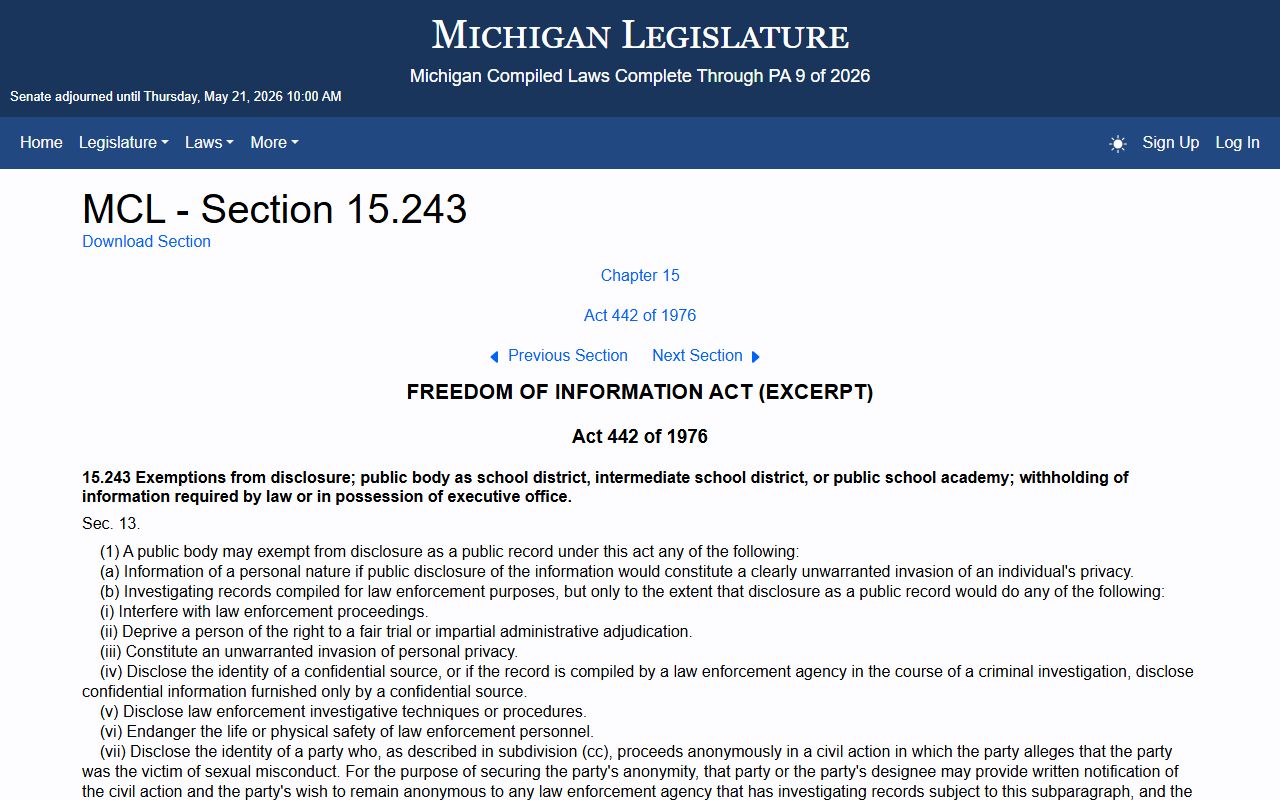
A denial that does not cite a real exemption from this list will not stand on appeal.
Vital Records, Deeds, and Other County Clerk Records
The Kalamazoo County Clerk wears two hats. One hat is the Register of Deeds, which records real property files. The other hat is the clerk of the 9th Circuit Court, which handles felony, divorce, family, and higher-value civil case files. The same office also runs elections, holds business assumed-name filings, and issues vital records.
Vital records the Clerk holds in Kalamazoo include marriage licenses and certificates, birth records, and death records. Divorce judgments route through the same office because the 9th Circuit Court enters them. Each vital record has its own access rule. A birth record stays restricted for many years. A marriage record opens sooner. A death record opens to a broader group. Apply to the Clerk for a copy. Bring photo ID. Bring a fee.
Register of Deeds work covers real property. Deeds, mortgages, liens, assignments, releases, and land contracts are recorded here. The Register's index is open to the public. The full image of any recorded instrument is also open, except for limited redactions under Michigan land-record rules.
Business and election files round out the Clerk's role. Assumed-name (DBA) filings sit here. County election results sit here. Notary commissions sit here. Each file type uses its own form and its own fee. A request to the Clerk should name the file type clearly.
For marriage and divorce, see marriage and divorce records. For estates and guardianships, see probate records. For the Clerk office in full, see County Clerk.