
How to Search Kalamazoo County Court Records
The official search portal for Kalamazoo court files is MiCOURT Case Search, run by the Michigan judiciary. MiCOURT pulls case data from the trial courts that serve Kalamazoo County. The portal uses a court-route URL so a user can land on the correct trial court before typing a name. That step matters. A misdemeanor or traffic case lives in the 8th District Court route. A felony, divorce, or higher-value civil case lives in the 9th Circuit Court route. An estate, guardianship, or conservatorship case lives in the Probate Court route. The portal uses hCaptcha for bot protection, and certain advanced views push the user toward a Michigan judiciary login. Most ordinary case lookups run with no login at all.
Before opening MiCOURT, gather what you know. A case number is best. A clean last name comes next. A birth year narrows common names. Filed-date and offense-date ranges help when a search returns too many hits. Have a ticket, summons, prior docket printout, or attorney letter nearby. Each one usually carries the case number you need.
The steps below cover the basic case search. The same flow works for district, circuit, or probate routes.
- Open the correct court route in MiCOURT: D08 for district, C09 for circuit, or P39 for probate.
- Type the party last name, or paste the case number if a ticket or notice gave you one.
- Add a birth year, case year, or case type when a name search returns too many results.
- Filter by case status, filed-date range, or offense-date range to trim the list further.
- Open a result to view the case header, parties, events, hearings, charges, and bond data.
- Use the payment link, where one shows, to clear a payable district-court matter.
- Request a certified copy or a sealed-file view through the clerk when MiCOURT does not show the full file.
An empty result does not always mean the case does not exist. The case may sit in a different trial court level. A felony bound over from district to circuit lives in C09 after bindover. A probate file does not appear in D08 or C09. Check the court selector first when nothing comes back. Sealed, juvenile, adoption, and mental-health files may not surface in a public search at all.
The SCAO forms library hosts the State Court Administrative Office form set used across Michigan trial courts. The forms cover small claims, garnishment, eviction, name change, set aside, and many other case types tied to the records that the trial courts produce.
The Michigan Courts site also publishes the SCAO district-court forms index, which feeds straight into the kinds of filings that show up on the district-court docket.
Kalamazoo County Court Records Search Fields
MiCOURT exposes the same field set across the three Kalamazoo court routes. Most fields are optional, but at least one identifier is needed to run a useful search. The table below lists each field, its input type, whether it is required, and a short note on format.
| Field Label | Type | Required | Notes / Format |
|---|---|---|---|
| Last Name | Text | Conditional | Use surname or business name. Needed when no case number is on hand. |
| First Name | Text | Optional | Narrows a party search. Helpful for common surnames. |
| Middle Name | Text | Optional | Trims false matches for very common names. |
| Birth Year | Number | Optional | Cuts down hits without exposing a full date of birth. |
| Case Number | Text | Conditional | Use the exact format from the notice or ticket. |
| Case Year | Number | Optional | Useful when the case number starts with the year. |
| Case Type | Dropdown | Optional | Options load per court. District, circuit, and probate carry different lists. |
| Case Status | Multi-select | Optional | Open, closed, pending, disposed, and similar status flags. |
| Case Type SubCategory | Multi-select | Optional | Trims results inside a chosen case type. Court-dependent. |
| Filed Date From | Date | Optional | Use a date range when a name search returns too many hits. |
| Filed Date To | Date | Optional | Pairs with Filed Date From. |
| Offense Date From | Date | Optional | Useful for criminal or traffic matters. |
| Offense Date To | Date | Optional | Pairs with Offense Date From. |
| Professional Number | Text | Optional | Used in the separate professional/attorney search route. |
| Date of Birth | Date | Optional | Used in the background search route only. Full DOB is not shown in ordinary results. |
The search button runs the query through hCaptcha. The clear button resets cached options. Tab through the fields in the order shown to match the way the portal stores its search state.
Types of Kalamazoo County Court Records
Kalamazoo trial courts produce a wide mix of case files. The District Court hears one set. The Circuit Court hears another. The Probate Court hears a third. The case type drives the field layout and the public-access rules. The list below covers the main categories used across the three courts.
- District civil: small claims, landlord-tenant summary proceedings, land contract forfeiture, and general civil cases inside district-court limits.
- District criminal: misdemeanors, felony arraignments, bond hearings, probable-cause conferences, and preliminary examinations.
- Traffic and civil infractions: moving and non-moving violations, OWI/DUI criminal traffic, and local ordinance matters.
- Circuit civil: higher-value civil disputes, personal injury, business cases, and appeals from administrative or lower-court rulings.
- Circuit criminal: felony trials, pleas, and sentences after bindover from district court.
- Family division: divorce, custody, parenting time, child support, paternity, adoption, juvenile delinquency, and abuse/neglect.
- Probate: estates, wills, guardianships, conservatorships, trusts, and protective proceedings.
- Mental-health probate: civil commitment and treatment-order matters with limited public access.
- Personal protection orders: issued through circuit-court processes, with some redaction for safety.
- Name change: adult and minor name-change petitions filed in circuit court.
Each category has its own filing path and its own form set. The SCAO library carries most of the templates. Local resources point users at the right form for the right court, which keeps a clerk from rejecting a packet at intake.
What Kalamazoo County Court Records Show
A case detail page in MiCOURT can hold a long list of fields. Not every case carries every field. A district traffic ticket shows a thin file. A circuit felony shows a thick one with bond, charges, hearings, and a sentence block. The table below lists the common fields a public user can expect to see on a Kalamazoo case detail view.
| Field | What It Shows |
|---|---|
| Case Number | The unique case identifier, often coded by year and case type. |
| Court | 8th District Court, 9th Circuit Court, or Kalamazoo Probate Court. |
| Case Status | Open, closed, pending, disposed, adjudicated, dismissed, or sealed. |
| Parties | Plaintiff, defendant, petitioner, respondent, decedent, or ward, by role. |
| Attorneys | Attorney of record, firm, and sometimes a bar or professional number. |
| Filing Date | Date the complaint, petition, or citation was filed with the clerk. |
| Offense Date | Date of the alleged offense in a criminal or traffic case. |
| Charges | Charge description, statute or ordinance, count, and charge level. |
| Events / Docket | Each event in case order: filing, service, motions, orders, hearings. |
| Hearings | Hearing date, time, judge or magistrate, and hearing type. |
| Bond | Bond number, amount, arrest date, posted date, and bond status. |
| Disposition | Plea, verdict, dismissal, or judgment outcome by count. |
| Sentence | Jail, prison, probation, fines, costs, and restitution terms. |
| Financial Orders | Fines, costs, fees, judgment balance, and garnishment data. |
| Documents | Some PDFs may be visible; many copies still require a clerk request. |
| Redactions | SSN, full DOB, account numbers, minor names, and protected addresses are masked. |
A probate case adds fields tied to guardianship review, inventory amount, qualification dates, and party answer dates. A juvenile case may carry juvenile file status, custody status, and petition ID in a protected context. The public view trims those fields based on party role and statutory rules.
Public Access Framework
Michigan runs two overlapping access systems. Executive and local-government records sit under the Michigan Freedom of Information Act, the state law starting at MCL 15.231. Court case files sit under Michigan Court Rule 8.119 and the related court rules. The split matters. A FOIA letter to the sheriff or county administration can return a non-court record. The same letter sent to a court clerk for a case file will be answered under court rules, not under FOIA. Both systems lean toward broad public access. Both carry exemptions for privacy, safety, and statutory confidentiality.
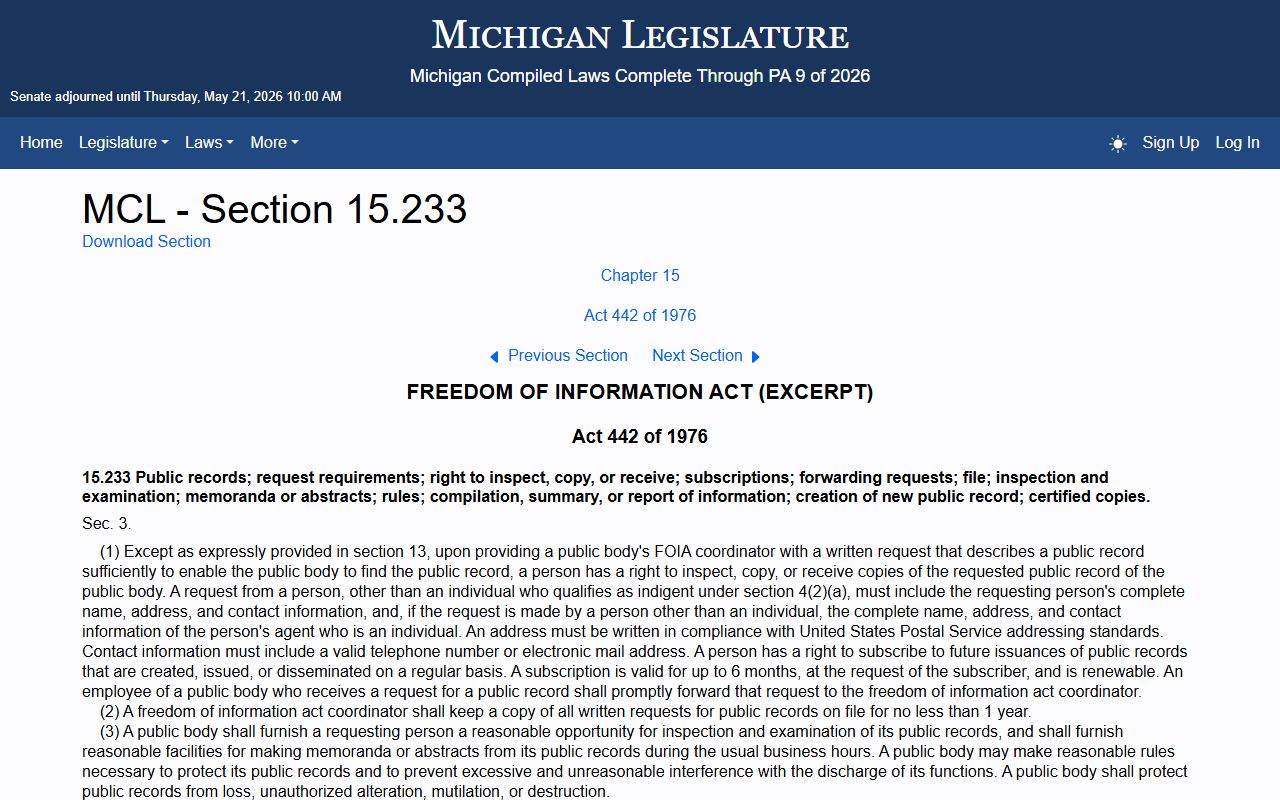
The FOIA right of inspection and copying sits at MCL 15.233. Fees are tied to labor, copying, and mailing costs, with itemized rules in the fee statute. Response timelines and denial rules sit under MCL 15.235. A requester who is denied may appeal to the head of the public body or file suit in circuit court. FOIA carries a long list of exemptions in MCL 15.243, including privacy, law-enforcement investigative materials, and records made confidential by other laws.
For court case files, request copies through the court clerk that holds the file. The clerk verifies identity for certified copies, applies court-rule fees, and screens out protected material before release. A walk-in request often produces same-day uncertified copies. A certified copy may take longer. A mailed request adds time for return postage. Anyone can request a public case file. There is no residency rule for Michigan court records.
The screenshot below points to the FOIA copying statute, one of the two anchor rules for public administrative records.
Note: Public access in Michigan is the default for court files, but juvenile, adoption, sealed, mental-health, and personal-identifier data stay protected even when the rest of a case is open.
Records That Are Sealed or Confidential
Several Kalamazoo case categories sit outside ordinary public search. Juvenile delinquency and child protective files are restricted under MCL 712A.28 and the court rules that back it. Parties, attorneys, agencies, and persons with statutory authority can access more than the general public. Adoption files are confidential under MCL 710.67, with access by statutory eligibility or by court order. Mental-health probate files carry restricted clinical content. Grand jury and investigative materials stay nonpublic until disclosed by court order or by filing.
Michigan uses the term "set aside" for what the public often calls expungement. The application path sits under MCL 780.621. Eligible adult convictions may be set aside by petition. The Clean Slate provisions add an automatic set-aside path for qualifying records after statutory waiting periods. A set-aside order removes the conviction from ordinary public criminal-history access. Law enforcement, courts, prosecutors, and some licensing contexts may still hold limited access. Common disqualifiers include offense type, number of convictions, waiting-period gaps, pending charges, and statutorily excluded serious offenses.
A petition to view a sealed Kalamazoo court file goes to the judge who sealed it or to the court that holds the record. The petition explains the requester's interest, the legal basis, and the specific records sought. A judge reviews the petition under the court rules and may grant full, partial, or no access.
In-Person Court Record Requests
Walk-in requests work well for fast lookups and certified copies. The downtown courthouse houses the 8th District Court and serves as the main public counter for district-court case records. Bring a valid ID, the case number if you know it, payment for any clerk fees, and exact party names. Mailed requests use the district court's Court Record Copy Request Form. The county also runs a general record requests page that points users to the right office for each record type.
8th District Court
227 West Michigan Avenue
Kalamazoo, MI 49007
Circuit Court files often route through the County Clerk for case-file copies, while district records run through the district-court clerk window. Probate files run through the Probate Court counter. Confirm the right counter before you drive over. The county courts split across more than one building, and the wrong address can mean a wasted trip.
Note: Bring exact spelling for party names and the case year. A typed search at a clerk window pulls the same file set you would see in MiCOURT, but staff cannot guess at common-name variations.