
How to Look Up Kalamazoo County Jail Population Data
Kalamazoo County jail population data does not live on a single page. The most useful starting points are the Kalamazoo County Sheriff's Office and the Jail Information page. Both pages give the public the official jail address, contact route, and operational guidance. They do not publish a live daily count of inmates. For a current snapshot, the Sheriff Inmate Inquiry portal exposes the public roster. A roster count is not a budget number. It is a real-time list of people booked into the jail within the chosen date window.
For audited population numbers, the right source is a county budget document, an annual sheriff report, or a state jail inspection report. The federal Bureau of Justice Statistics jail series and the Vera Institute's Incarceration Trends project both publish county-level historical context. BJS data is national in scope but releases county-level files in some years. Vera pulls from public sources and may lag the most recent year. Each source uses its own update cadence. Sheriff pages can change daily. Budget reports come out once a year. BJS jail tables come out on a state and national release schedule, not in real time.
Kalamazoo County Jail Capacity Overview
Capacity is the number of beds a jail is rated to hold under its operating plan. It is not the same as the daily count of inmates. A jail can run under or over its rated capacity for short periods. Some facilities post their bed count in an annual report. Others publish it only inside county budget documents or state inspection forms. The Kalamazoo County Sheriff's Jail Information page is the official entry point for jail operations. The captured public text does not expose a rated bed count.
| Facility | Rated Capacity | Average Daily Population | Source / Gap |
|---|---|---|---|
| Kalamazoo County Jail | Capacity not located in captured official source; verify with Sheriff | ADP not located in captured official source; verify with annual report | Jail Information page; annual report and county budget need follow-up |
Anyone who needs a hard capacity figure should call the Sheriff's Office through the contact route on the official jail page or file a public records request for the most recent annual report. The county budget book often lists corrections cost lines, staffing, and bed counts. State jail inspection records may also list a rated capacity. Capacity can shift when housing pods are taken offline for repairs or staffing reasons, so the published figure is a baseline, not a daily limit.
Note: Capacity, current count, and average daily population each measure something different. Mixing them gives a misleading picture of how full a jail runs.
Average Daily Population
Average daily population, or ADP, is the mean count of inmates held in a jail across a full year. It is the standard number used in jail reports and county budgets. ADP smooths out the daily ups and downs caused by weekend bookings, holiday slowdowns, court schedules, and short-term transfers. A snapshot taken on one day can be much higher or lower than the yearly average. ADP for Kalamazoo County Jail was not located in the captured official sources reviewed for this page.
Three terms get mixed up often. Each one means a different thing. Understanding the gap helps when reading any county jail report.
| Term | What It Measures | Time Frame |
|---|---|---|
| Current Count / Roster Count | People in jail at one moment, taken from the live booking system | Right now, or the last refresh of the roster |
| Average Daily Population (ADP) | Mean number of inmates held each day across a defined period | Usually one fiscal or calendar year |
| Annual Admissions / Bookings | Total number of intake events in a year, not the same as unique people | Twelve months |
A jail with a low ADP can still have a high bookings number if it processes many short stays. A jail with a high ADP can have fewer admissions if it holds a larger share of long-term pretrial or sentenced detainees. Both metrics matter. The Sheriff Inmate Inquiry portal can give a snapshot of current custody on a chosen date, but it does not give an annual ADP.
Demographic Breakdown
Jail demographics describe the population by race, gender, age band, and sometimes ZIP code or commitment status. The public roster pages expose race and gender fields per inmate, but a roster is not a demographic report. A demographic report aggregates the population across a defined time window and is signed off by jail administration. Captured Kalamazoo County sources did not publish a demographic breakdown of the jail population in the official pages reviewed.
Most county jail demographic reports cover four basic splits. Race and ethnicity. Gender, including male, female, and where reported, nonbinary. Age, grouped in broad bands such as 18 to 24, 25 to 34, and so on. Booking origin, which can include arresting agency or originating court. A few counties publish more detail, such as veteran status or housing status at intake.
National context comes from the Bureau of Justice Statistics jail series, which publishes race, sex, and age data at the state and national level. BJS figures should not be used as a Kalamazoo County figure. They show a pattern. They do not show this jail. For local numbers, the right ask is a public records request to the Sheriff or a search of the most recent county annual report. Demographic data is sensitive, so jails redact small cell counts that could identify a single inmate.
Pretrial vs Sentenced Population
Most county jails hold a mix of pretrial and sentenced inmates. Pretrial means the person has been arrested and charged but has not been convicted. Sentenced means a court has entered a finding of guilt and a jail term. Pretrial detainees often make up the larger share of the daily count in county jails across the country, because state prisons take most felony sentences after conviction. The exact Kalamazoo County split was not published in the captured official sources, so this page does not assign a county-specific percentage.
| Category | Who Belongs Here |
|---|---|
| Pretrial detainees | People charged but not yet convicted; held on bond, no-bond orders, or unable to post. |
| Sentenced misdemeanants | People serving a jail term after a misdemeanor conviction in district court. |
| Sentenced felons (short term) | Felony sentences served in local jail rather than state prison, where the term fits the local-time rule. |
| Probation violators | People held on a probation violation hold while a review or revocation hearing is pending. |
| Parole holds | State parolees held on a parole detainer or new charge. |
| Holds for other agencies | People held on a writ, federal detainer, or out-of-county warrant. |
| Sentenced weekend/work release | People serving intermittent jail time on a court-ordered schedule. |
Each category drives a different operational cost. Pretrial inmates may need more court transport. Sentenced inmates may need programming and work-release coordination. Holds may need extra paperwork with the requesting agency. A jail report that lumps all of these into one number hides the real workload.
Misdemeanor vs Felony Population
The other common split is by offense level. Misdemeanors are lower-level offenses handled in district court, including most traffic misdemeanors, simple assault, retail fraud at low dollar amounts, and many drug possession charges depending on the substance. Felonies are more serious offenses heard in circuit court after bindover from district court. A felony can result in prison time, probation, or local jail time depending on the sentence. The Kalamazoo County jail holds people in both buckets at different stages of the case.
The captured Kalamazoo County sources did not publish the exact misdemeanor versus felony share of the jail population. National jail surveys show that pretrial felony holds often make up a meaningful share of the count, because felony cases take longer to resolve than misdemeanors. Anyone who needs the local breakdown should request it from the Sheriff's Office or review the most recent county annual report.
A few things shift the mix. Bond practices in the local district and circuit courts. Speedy trial timing. The pace of probable-cause conferences and preliminary exams in district court. Sentencing patterns in the 9th Circuit Court and the 8th District Court. The use of pretrial release programs and electronic monitoring. Each lever can change the mix month to month.
Mental Health and Medical Population
Most county jails hold a meaningful share of inmates with mental health needs, substance use needs, or chronic medical conditions. National surveys consistently show that a large share of jail inmates report a mental health condition, a substance use disorder, or both. County jails are usually not built as treatment facilities, so the population that needs care creates real operational pressure. Crisis intervention, medication continuity, withdrawal management, and competency evaluations are common workflows.
Exact numbers for the Kalamazoo County Jail's mental health and medical population were not located in the captured official sources. Some counties publish this in annual reports or jail studies. Others release the data only under a records request. Pretrial competency cases can route through specialty court programs or state hospital placement, which changes the jail count for those inmates. Sentenced inmates with serious medical needs may be transferred to a hospital or to a different facility under a corrections health plan.
The public-records route through Michigan's FOIA, set out in MCL 15.231, applies to executive-branch agency records, including Sheriff administrative records. Court-side records, including competency orders, go through the clerk of the court that owns the case.
National and State Context
National and state context helps a reader judge whether a county jail count is high, low, or near the middle. The Bureau of Justice Statistics publishes the federal jail series, including annual jail inmate counts, jail incarceration rates per 100,000 residents, and demographic splits at the state and national level. The Vera Institute Incarceration Trends project compiles county-level historical data on jail and prison populations across the United States, drawing on BJS and state sources.
National jail counts and rates per 100,000 are useful as background, not as a Kalamazoo County figure. They show how Michigan and its peer states compare. Michigan state corrections data on sentenced prisoners is published by the Michigan Department of Corrections through its prisoner data routes. The MDOC numbers cover prison, not county jail, so they do not replace a Kalamazoo Sheriff report. Vera county pages can be useful for long-run historical context but should be labeled as research, not as official county data.
For accurate comparisons, the same metric must be used on both sides. A national figure expressed as ADP per 100,000 residents should be compared to a county ADP per 100,000, not to a roster snapshot. Pulling a one-day Kalamazoo roster count and comparing it to a yearly national average is not a fair comparison.
Population Trends Over Time
Multi-year jail population trends show whether a county jail is growing, shrinking, or holding flat. A useful trend report uses the same metric across years, usually ADP, and notes any major policy or operational change in each year. Bond reform, pretrial release expansion, new specialty courts, COVID-era release orders, and changes in arrest patterns can all move the number. No official five-year Kalamazoo County jail population trend was captured in the sources reviewed for this page.
For verified Kalamazoo County trends, the right sources are:
- Kalamazoo County budget books, which often include corrections operating budgets and staffing trends year over year.
- Sheriff's annual reports, when published, with jail bookings, ADP, and program counts.
- County jail needs assessment reports, when commissioned, with facility utilization data.
- Kalamazoo County Board of Commissioners agenda packets, which can include corrections updates.
- State jail inspection reports, which set rated capacity and review compliance.
- BJS jail tables and Vera Incarceration Trends pages, for longer historical context.
Anyone who wants to build a Kalamazoo trend chart should pull the same data point (ADP or year-end roster) from each source year and label the methodology. Mixing a one-day roster from one year with an ADP from another year does not make a real trend. A public records request under Michigan FOIA can request the data series directly from the Sheriff.
Searching for Kalamazoo Inmate Records by Name
This page covers population data. For individual-name lookups, current custody status, booking date, bond amount, and charge detail on a specific person, go to the Kalamazoo County inmate records page. That page covers the public Sheriff Inmate Inquiry portal and the right field set for a roster search. For release verification, see released inmates.
Where the Data Comes From
Several sources feed the Kalamazoo County jail population picture. Each one answers a different question. The Sheriff's Office is the operating agency for the jail. Its Jail Information page is the official starting point for facility detail, contact route, and operational policies.
The Sheriff page below points to the live operational source for the jail.
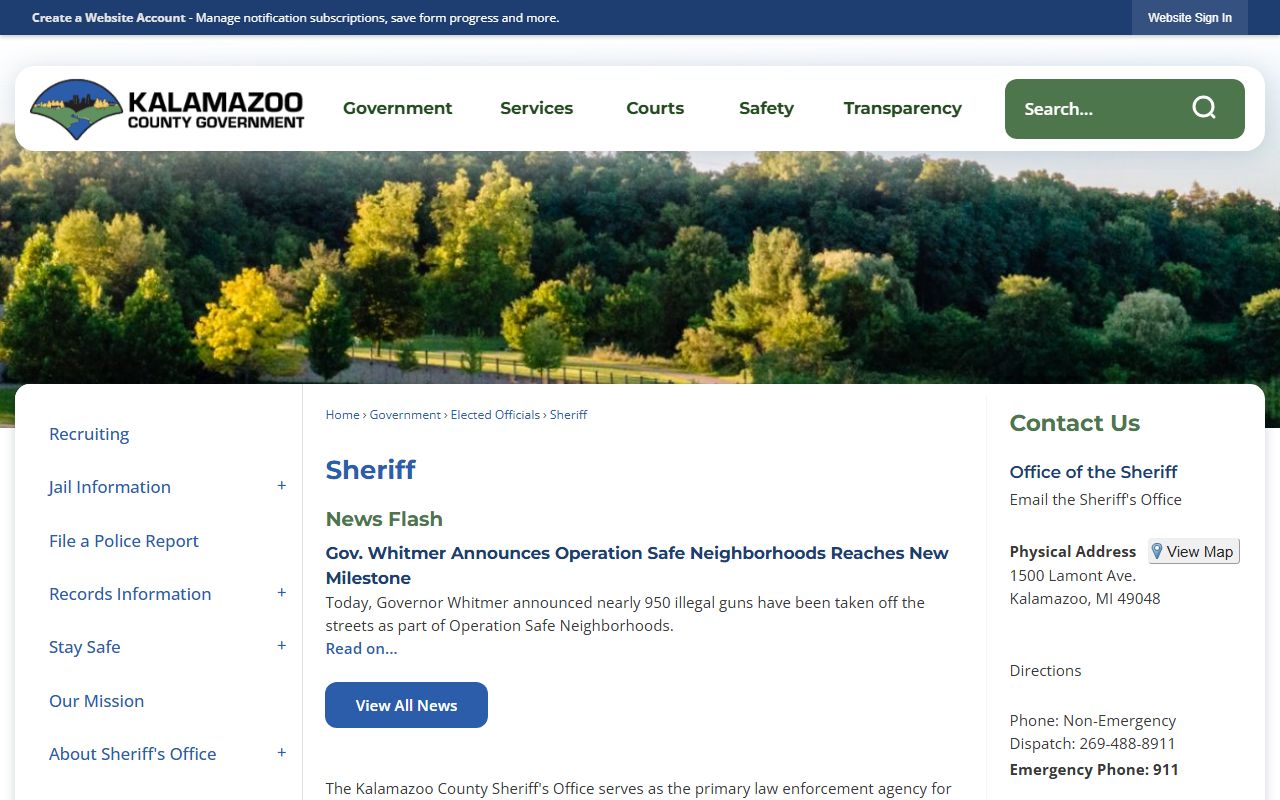
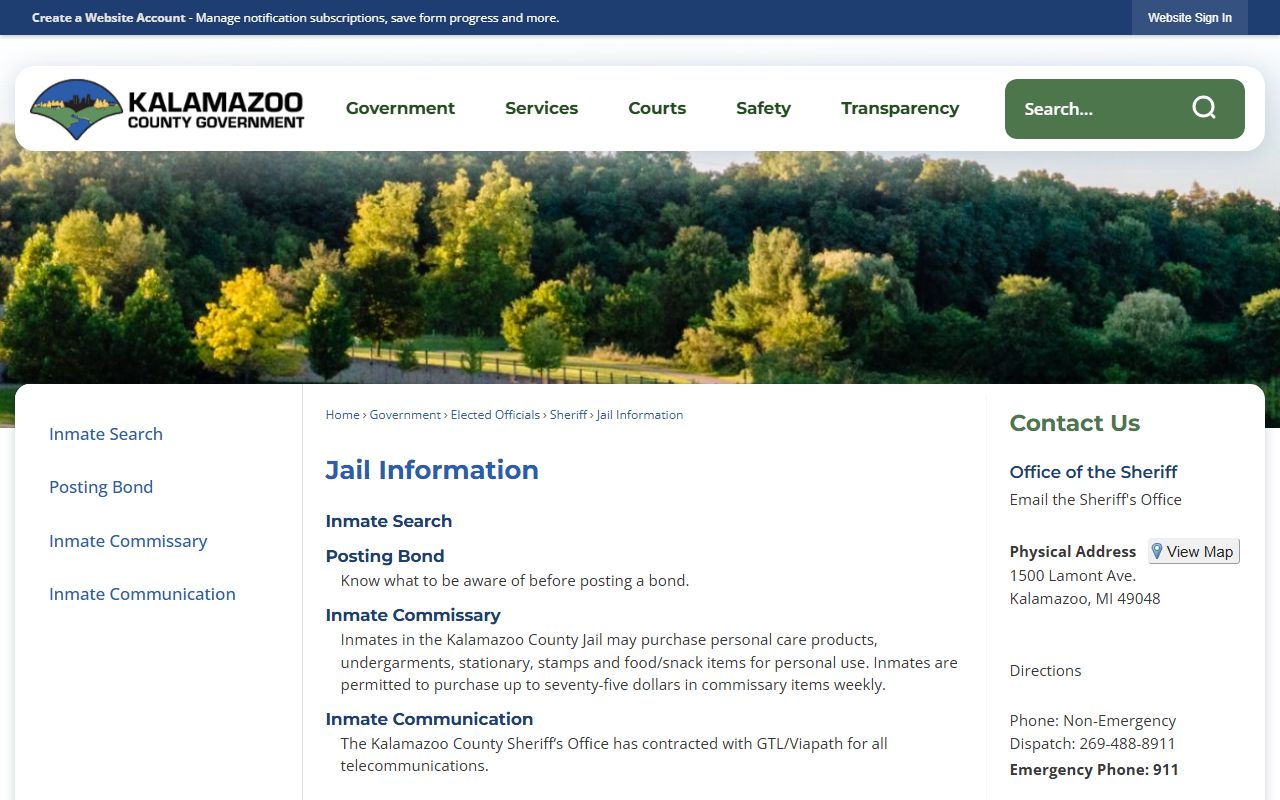
From there, users land on the jail information page for visiting, mail, and contact detail.
The dedicated jail information page is also linked below for direct access.
For audited annual numbers, Kalamazoo County budget books and any published Sheriff annual reports are the official source. The county FOIA route under MCL 15.231 applies to executive-branch records held by the Sheriff. The County Clerk holds court-side filings, including criminal case records that drive bookings, through the County Clerk office. The 9th Circuit Court and the 8th District Court set the bond and sentencing patterns that shape the jail count.
For state and national context, the Bureau of Justice Statistics and the Vera Institute are the two reliable research sources. Each one labels its data range and methodology. Neither replaces a Kalamazoo Sheriff report. For more answers on inmate questions, see the Kalamazoo County Court Records FAQ.