
Where Kalamazoo County Marriage and Divorce Records Live
Two offices hold the bulk of family vital records in Kalamazoo. The first office is the County Clerk and Register of Deeds. The clerk runs the local vital records function. Marriage licenses are issued there. Certified marriage copies are pulled there. The official source for the local marriage license workflow is the Kalamazoo County vital records page. The clerk landing page is the County Clerk and Register of Deeds portal, which connects all clerk services in one place.
The second office is the 9th Circuit Court family division. A divorce is a circuit-court family case. The case opens with a complaint and ends with a final judgment of divorce. The official source for the court is the 9th Circuit Court page. The state portal route is MiCOURT C09, and the local 9th Circuit Court records overview lives on this site too.
A certified divorce copy is a circuit-court record. The state vital records office at Michigan MDHHS vital records may also provide divorce verification, but the judgment itself stays with the circuit clerk. Marriage records and divorce records do not share a single search box. They share a workflow logic.
Quick map of who holds what:
- Marriage license application : County Clerk vital records.
- Certified marriage copy : County Clerk vital records.
- Divorce filing and judgment : 9th Circuit Court family division.
- Friend of the Court support and parenting time : Friend of the Court.
- Probate of estates after death of a spouse : Kalamazoo County Probate Court.
How to Apply for a Kalamazoo County Marriage License
The marriage license application is a county-clerk task, not a court task. The clerk reviews proof of age, identification, residency, and the fee before the license is issued. The clerk also handles the post-ceremony return of the license by the officiant. Steps follow the local vital records workflow.
- Read the marriage license instructions on the Kalamazoo County vital records page before going to the office.
- Confirm the current rules on age, ID, residency, waiting period, and fee on the official page. Rules change. Check the live page.
- Apply through the County Clerk and Register of Deeds process listed on the vital records page. Bring valid government identification for each applicant.
- Sign the application in the format the clerk requires. Some steps may be in person. The official page is the source of truth.
- Receive the license. Plan the ceremony. The license is valid for the time set by Michigan law and the local page.
- After the ceremony, the officiant returns the license to the County Clerk for recording. The marriage is not on file until the return is processed.
- Order a certified marriage copy after the record is on file. Use the County Clerk vital records process, or use the state vital records office if needed.
Note: rules on residency, age, and waiting period are set by state law and local practice; always verify current details on the official Kalamazoo County vital records page before you travel to the clerk.
The screenshot below points to the Michigan SCAO forms library, the right source for many family-court forms used in divorce cases that follow a marriage record. The SCAO forms portal hosts the official Michigan court form set.
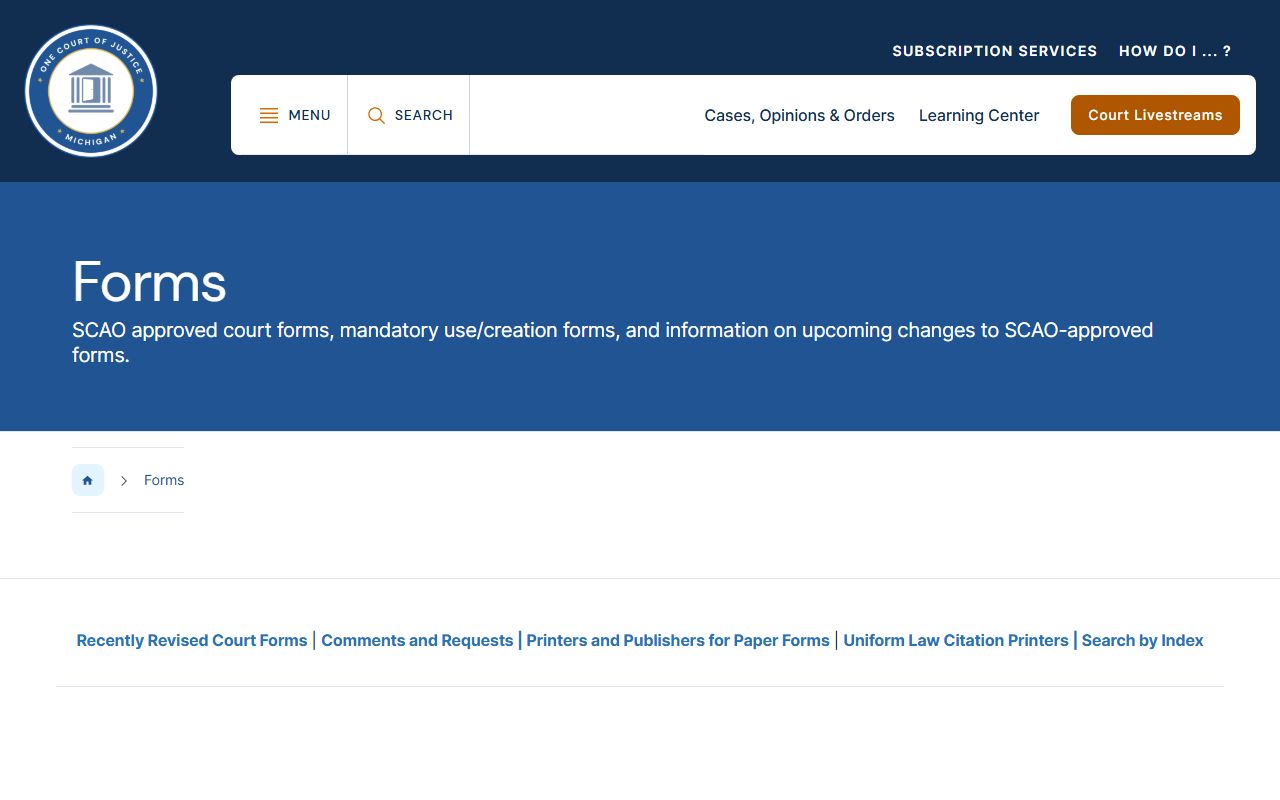
That portal is the same library the clerk and circuit-court staff point users to when the question is a family-law form.
Marriage License Application Form Fields
Fields on the marriage application follow a standard pattern. The exact form lives on the County Clerk vital records page. The table lists the core fields seen across Michigan county marriage-license workflows. Verify the live form before you fill it out.
| Field Label | Type | Required | Notes |
|---|---|---|---|
| Applicant 1 name | Text | Yes | Legal name as shown on government identification. |
| Applicant 2 name | Text | Yes | Legal name as shown on government identification. |
| Date of birth / age | Date / Text | Yes | Verify legal age and ID rules on the official page. |
| Address / residency | Text | Yes | Drives county and state application rules. |
| Identification | Upload / in person | Yes | Government photo ID is the usual baseline; verify on the live page. |
| Ceremony / officiant information | Text | After ceremony | The officiant returns the license to the clerk for recording. |
| Certified copy request | Form | Optional | Names, date of marriage, and requester details for a certified copy. |
Most fields are simple. Two are easy to miss. The address field is what tells the clerk which county and state rules apply, and the officiant field is what triggers the post-ceremony recording step.
Michigan Marriage Rules at a Glance
Michigan marriage law is short on quirks. A few key rules cover most questions before the clerk visit.
- No blood test is required under current Michigan marriage licensing rules.
- Marriages must be solemnized by an officiant authorized under state law. Judges, certain clergy, and other authorized officiants qualify.
- Same-sex marriage is recognized in Michigan after the Obergefell decision and state compliance.
- Michigan does not create common-law marriage by cohabitation alone. Older or out-of-state recognition questions need legal advice.
The list above is a quick reference, not legal advice. A user with a fact pattern that crosses state lines, prior marriages, or annulment claims should talk to a lawyer before relying on the summary.
Filing for Divorce in Kalamazoo County
A divorce is a 9th Circuit Court family division case. The case files at the circuit clerk side of the County Clerk office, then runs through the family division docket. The state SCAO forms library at courts.michigan.gov/SCAO-forms holds the domestic relations forms used in Michigan divorce practice. The general flow is steady, even though every case has its own facts.
- Confirm jurisdiction and residency. Michigan and Kalamazoo County have residency rules a filer must meet before filing.
- Prepare the complaint for divorce and the supporting domestic relations forms using the SCAO form library or attorney drafting.
- File the complaint with the circuit-court side of the County Clerk. Pay the filing fee or request a fee waiver if eligible.
- Serve the other party with the summons and complaint, unless an acceptance of service or waiver is signed.
- Address temporary orders early. Temporary custody, parenting time, support, and use of property are common temporary-order topics.
- Work through custody and parenting time. The court applies the best-interest factors and may order an evaluation.
- Address child support using Michigan child support guidelines. The Friend of the Court office is the long-term enforcement engine.
- Address property division and any spousal support claims. Marital property is split equitably under state law.
- Finalize by consent judgment, default, contested hearing, or trial. The judgment of divorce ends the marriage and sets the terms.
A judgment of divorce can include custody, parenting time, child support, spousal support, property division, debt allocation, name change, and protective terms. The judgment is the operative document. After entry, it is the controlling order for both parties unless modified by a later court order.
Self-represented filers can find guides and toolkits at Michigan Legal Help. The state self-help site has divorce, custody, and parenting-time pathways tailored to Michigan practice. The local 9th Circuit Court record overview also covers circuit-court basics.
Friend of the Court Role
The Friend of the Court office is a circuit-court office in Michigan that focuses on family cases. The office handles child support enforcement, parenting-time complaints, and recommendations to the judge on contested family issues. The local office is the Kalamazoo County Friend of the Court, and its page lists contact paths and program access.
Three common reasons a person calls Friend of the Court:
- Support is not being paid, or the amount needs review and adjustment.
- Parenting time is being denied or the schedule needs fix-up help.
- An income withholding notice, license suspension, or show-cause hearing has been issued.
Friend of the Court is not a substitute for a motion in front of a judge in every case. Some disputes need a formal motion. The office can explain when a motion is the right next step.
The next image points to the local Friend of the Court page, the live source for service hours, forms, and current rules.
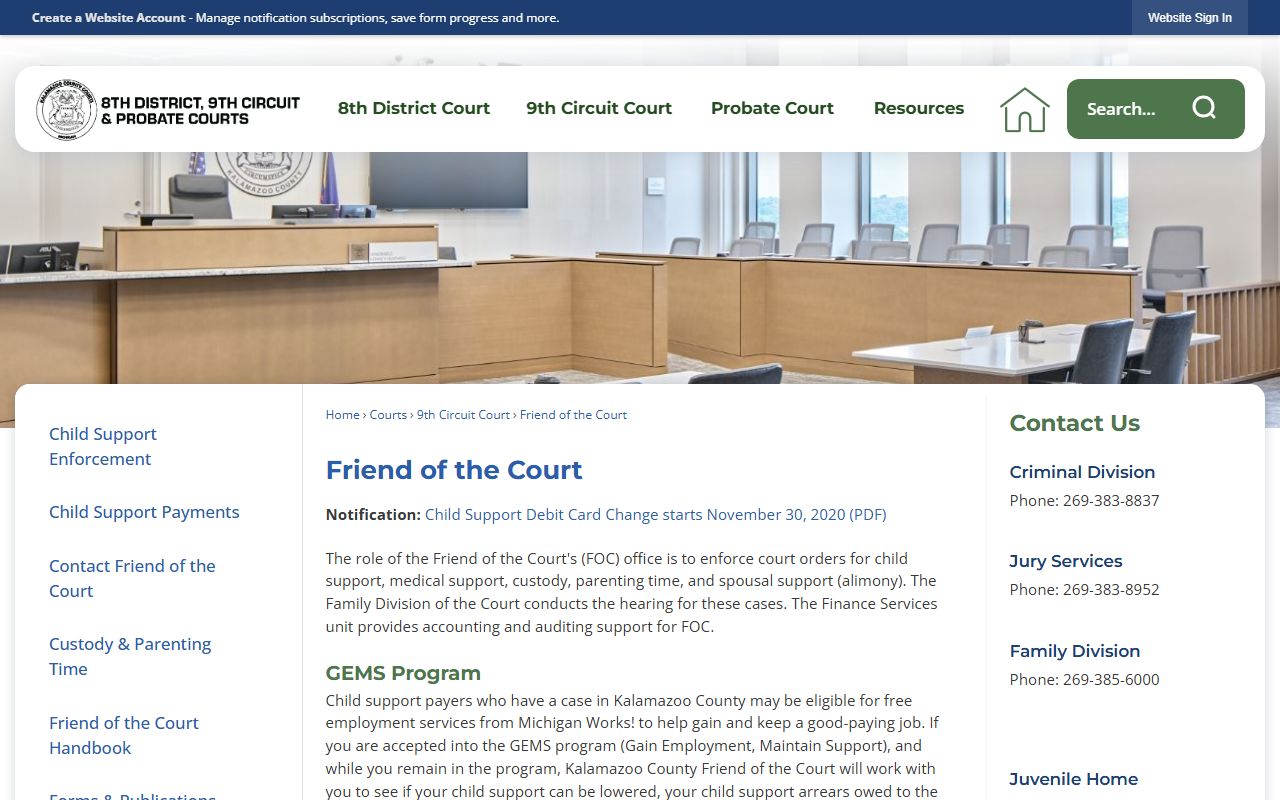
That page is the right starting point for any support, parenting-time, or enforcement question in a Kalamazoo case.
How to Get a Certified Marriage or Divorce Copy
A certified copy is the official paper version of a record, signed and sealed by the clerk. Banks, agencies, courts, and consulates often ask for a certified copy, not a plain printout. The route depends on the record type.
For a certified marriage copy, the request goes to the Kalamazoo County vital records office at the County Clerk and Register of Deeds. The request form asks for the full names of the spouses, the date of marriage, and the requester's identification and contact details. Fees apply. Verify the current fee on the official page before sending payment.
For a certified divorce judgment copy, the request goes to the circuit clerk side of the County Clerk office, because the judgment is a circuit-court file. The state MDHHS vital records office may provide divorce verification for some requests. The judgment of divorce itself stays with the circuit clerk.
A quick checklist before you send a request:
- Have the full legal name of each spouse, including maiden names if used at the time of marriage.
- Have the date of marriage or date of divorce as close as you can get it.
- Have the case number for a divorce, if you have it. A name search works without one.
- Have valid identification ready, in the form the office requires.
- Confirm the current fee on the live County Clerk page before mailing payment.
Fees for Marriage Licenses and Certified Copies
Fees change. The county sets some fees by ordinance, the state sets others by statute, and the office can update the schedule without much public notice. The table below lists the items the public asks about most. Verify each amount on the official page before you mail a check or stand in line.
| Item | Amount | Source / Notes |
|---|---|---|
| Marriage license | Verify on official page | Live source: Kalamazoo County vital records. |
| Certified marriage copy | Verify on official page | Live source: County Clerk vital records. |
| Certified divorce judgment copy | Verify on official page | Live source: 9th Circuit Court / County Clerk; state vital records may handle verification. |
| Divorce filing fee | Verify on official page | State and county filing-fee schedule applies; fee waiver may be available for indigent filers. |
| SCAO form library | No charge to download | Forms are free at the state SCAO portal. |
Fee waivers are a real option for filers with low income. The state SCAO form library has a fee waiver application. The clerk can point a self-represented filer toward the right form. Ask before paying.
Confidential Family Details
Family-court files are partly public. They are not fully open. Michigan law restricts certain categories of information inside a divorce file and in related juvenile or adoption matters.
The categories below are common restrictions and protected items:
- Full Social Security numbers of parties and minor children.
- Financial account numbers shown on bank statements, retirement statements, and tax forms.
- Names and identifying details of minor children when the court orders limited disclosure.
- Juvenile delinquency and child-protective records under MCL 712A.28.
- Adoption records under MCL 710.67.
- Mental-health and substance-use evaluations submitted to the court.
- Domestic violence safety-related addresses for protected parties.
A divorce judgment is a public record in most ordinary cases, but the file behind it can hold sealed exhibits, sealed financial disclosures, and sealed custody evaluations. To view a restricted record, a person must usually be a party, an attorney of record, or authorized by court order.
- Family Division
- The part of the 9th Circuit Court that hears divorce, custody, parenting time, child support, paternity, juvenile, and related family cases.
- Friend of the Court
- A circuit-court office that handles support enforcement and parenting-time issues, and that may make recommendations to the judge.
- SCAO
- The State Court Administrative Office, which publishes Michigan's official court forms and case-management standards.
- Certified Copy
- A signed and sealed copy of a record issued by the clerk, suitable for use by banks, agencies, and courts.
- Officiant
- The person authorized to perform the marriage ceremony and to return the signed license to the clerk for recording.