
How to Find Kalamazoo County Arrest Records
Most Kalamazoo County arrest searches start at one place. The Sheriff Inmate Inquiry portal is the live county booking lookup. It runs on the county emergency-services domain and does not need a login. The default search filters for current custody, which is fine when the question is "who was just booked." For older bookings, the date range and the In Custody checkbox both need a small change. Once the booking record points to a charge, the case file follows on the state court portal. MiCOURT splits Kalamazoo into three routes, but most arrest follow-ups land in the district-court or circuit-court routes.
The Kalamazoo County Sheriff's Office page is the live source for jail contact, mailing rules, and visitor policy. The Jail Information page covers money deposits, intake, and visiting. These pages do not host the booking lookup, but they explain how booking works and how to confirm a release.
Use the steps below to run a clean search.
- Open the Sheriff Inmate Inquiry portal.
- Type a last name in the Name field. Add a booking number or subject number if the paperwork lists one.
- Leave In Custody checked when looking for someone the family thinks is still in jail. Uncheck the box to search past bookings.
- Adjust the Booking From Date and Booking To Date when the arrest was more than a few weeks back. The default range is short.
- Open the result name to see demographic data, booking date and time, the housing facility, total bond, total bail, and the booking charges table.
- For the matching court file, jump to MiCOURT. Use the 8th District Court route (D08) for misdemeanors and felony first appearances. Use the 9th Circuit Court route (C09) for felonies after bindover.
- Call the jail or the clerk to verify a same-day release or a same-day filing, since the portal can lag for a short window.
The screenshot below shows the official Sheriff's Office page, the right starting point for jail contact and arrest follow-up calls.
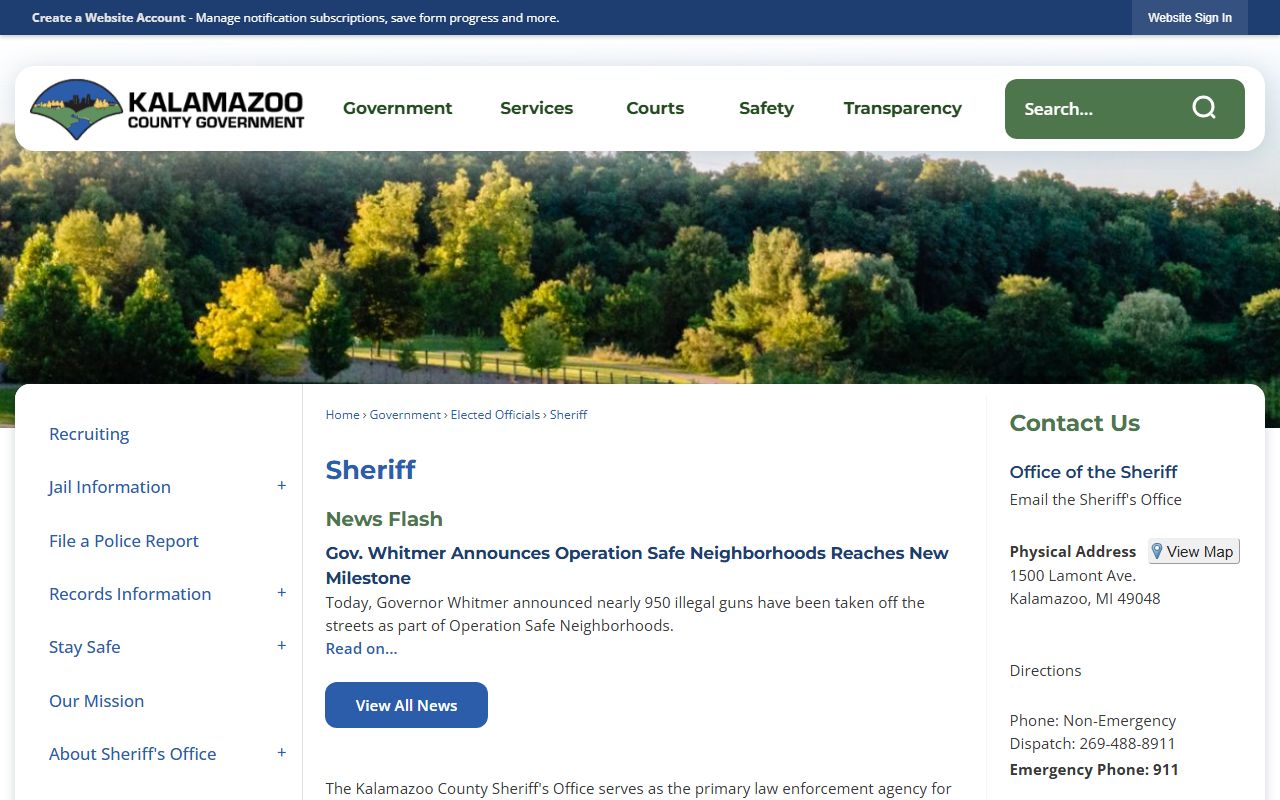
That page lists the contact route used by the staff who handle booking questions and visitation scheduling.
What Is in a Kalamazoo County Arrest Record
An arrest record is the paperwork that follows a person from the moment of booking through the first hours in custody. The Kalamazoo Sheriff Inmate Inquiry portal exposes a tight set of public fields. The list below comes from the captured public detail view of a sample inmate profile. Not every booking shows every field, and some details may not be visible in the public HTML at all.
| Field | What It Shows |
|---|---|
| Name | Booked person's full name as recorded at intake. |
| Age | Age in years at the time the page is viewed. |
| Gender | Public demographic field captured at booking. |
| Race | Public demographic field captured at booking. |
| Address | Recorded home address with city, state, and ZIP. |
| Booking Date | Date and time the booking record was created. |
| Housing Facility | Where the person is held. Captured value is Kalamazoo County Jail. |
| Total Bond Amount | Sum of bond required across all current bookings. |
| Total Bail Amount | Sum of bail across all current bookings. |
| Booking Bonds Table | Bond Type and Bond Amount per booking, including OR Bond or Cash or Surety entries. |
| Booking Charges Table | Charge Number, Charge Description, Offense Date, Disposition, Disposition Date, Sentence Length, Arresting Agency, and Bond. |
| Multiple Bookings | Result-list indicator when a person has more than one booking on file. |
Some fields people often expect are not in the captured public HTML. The portal sample did not show a date of birth, height, weight, hair or eye color, pod or cell number, court date, or judge name. A mugshot field was not observed in the public detail view either, so a Kalamazoo arrest record does not always carry a public photo even when other counties post one.
Note: A short delay between a fresh arrest and the public record is normal, since the booking page reads from the live records system and updates run in small batches.
Booking and the Kalamazoo County Jail
Booking is the formal process that turns an arrest into a public record. After the arresting agency brings a person in, jail staff record a name, demographic information, a booking date and time, the housing facility, and any bond or bail data. A charge table is built from the warrant, the complaint, or the arrest paperwork. The booking record then appears in the public inmate inquiry feed and may also feed downstream systems like victim notification.
Most public Kalamazoo arrest detail views show a Total Bond Amount and a Total Bail Amount as separate lines. Bond types observed in public detail include OR Bond and Cash or Surety. Some charge rows post a disposition line that reads as "Bond Posted" or similar text once the person clears the bond step. To check a same-day release, search with In Custody unchecked or call the jail through the official jail information page.
For the deeper roster view, the Kalamazoo County inmate records page covers the full field list, search filters, and result columns. The released inmates page covers VINELink, MDOC OTIS, and the right checkbox setting for past bookings.
The screenshot below shows the sample inmate detail view captured from the live portal. It points to the layout of the public booking page, not the live record of any one person.
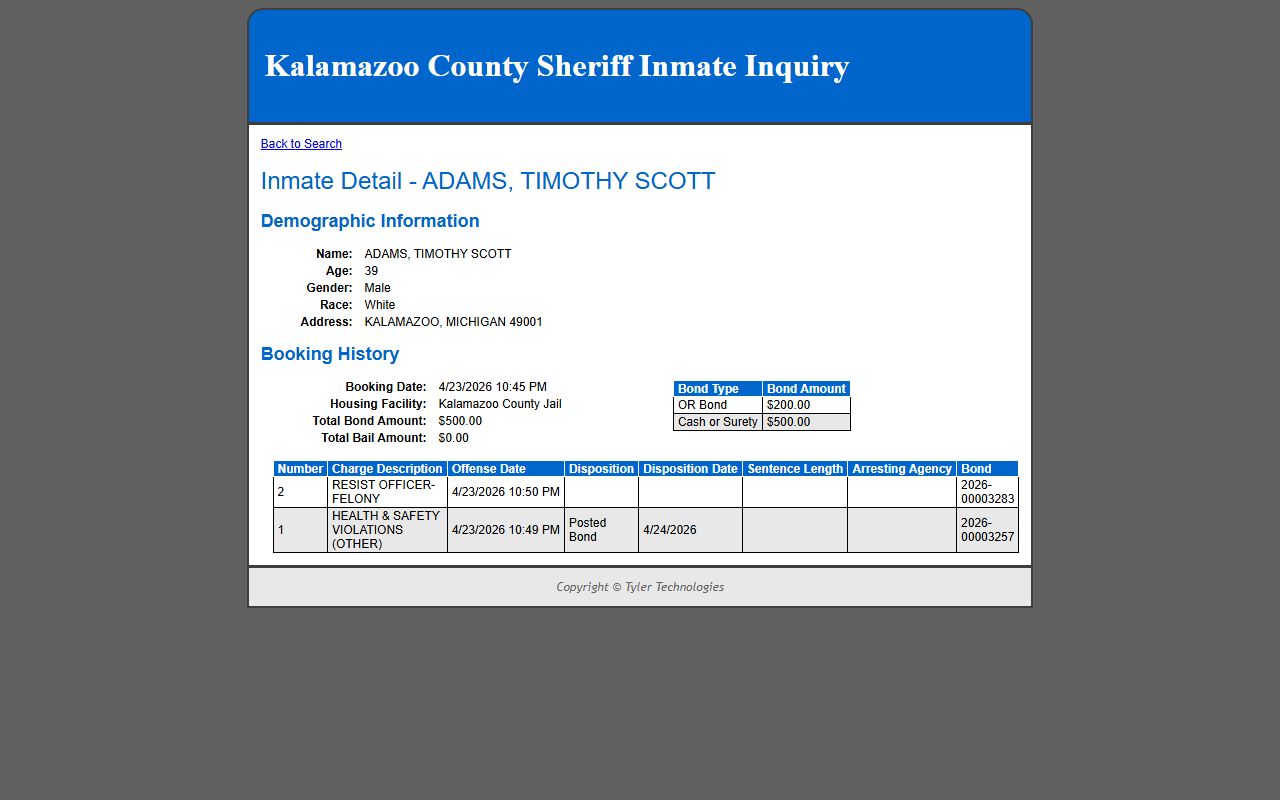
That layout is what a public user lands on after clicking a name in the inmate result list.
Arrest Records vs Criminal Court Records
Arrest records and criminal court records are not the same file. An arrest record is built by the law-enforcement agency that booked the person. A criminal court record is built by the court clerk when the prosecutor files a complaint. The two systems track different events, sit in different databases, and follow different access rules. Knowing the split saves time, because the wrong starting point produces a thin or empty result for the right person.
| Arrest Record | Criminal Court Record | |
|---|---|---|
| Custodian | Kalamazoo County Sheriff and arresting agencies. | County Clerk, 8th District Court, or 9th Circuit Court. |
| What It Contains | Booking demographic data, booking date, charges at intake, bond, bail, housing facility. | Complaint, warrant copy, motions, orders, plea, bond order, sentence, probation order, judgment. |
| Where to Access | Sheriff Inmate Inquiry portal and jail records desk. | MiCOURT case search and the clerk record-copy workflow. |
| When Created | At booking, often the same hour as the arrest. | When the prosecutor files the case in court. |
For the full case file route, the Kalamazoo court records page covers MiCOURT search fields, case-number formats, and clerk copy requests. The court dockets page covers the events list shown on the case-detail screen.
Charges vs Convictions
Charges and convictions are not the same thing, even though casual conversation uses the words almost as synonyms. A charge is an allegation filed by the prosecutor or set out in a complaint. A conviction is a finding of guilt by plea or verdict. A booking record can show a charge that never becomes a conviction. The arrest record will still exist as a public booking entry, but the court file will tell a different end-of-case story.
| Charge | Conviction | |
|---|---|---|
| What It Is | An allegation against the defendant. | A finding of guilt entered on the record. |
| Source | Prosecutor complaint or warrant. | Plea or verdict accepted by the judge. |
| When It Appears | At booking or at first court filing. | After plea, trial, or bench finding. |
| Effect | Triggers bond, hearings, and case events. | Triggers sentence, probation, fines, or set-aside eligibility. |
Reading the disposition field on every count is the simple fix for the most common mistake. A case can have one count dismissed and another count end in a plea. The summary line does not always show that split, but the per-count rows do.
Mugshots and the Kalamazoo Inmate Profile
The Kalamazoo inmate profile is built for public lookup, but it is not built around photos. The captured public HTML for the sample inmate detail page did not show a mugshot field. That is not the same as saying mugshots never exist for Kalamazoo arrests. Arresting agencies often take a booking photo as part of internal records. The point is narrower: the public inmate inquiry view captured here did not surface a photo, so a Kalamazoo arrest record may include a mugshot internally without posting one online.
Third-party mugshot sites are a different system entirely. They scrape data, post it without context, and sometimes attach pay-to-remove offers. The official county portal stays cleaner than the third-party version. For the public booking facts, the Sheriff Inmate Inquiry portal is the right source, and the missing photo on the public page is not a sign that the record is broken or hidden.
Sealed Records vs Expunged or Set-Aside Records
Michigan uses two related ideas that look the same to most users but work differently in practice. Sealed records and set-aside records both restrict public access, but the path and the effect are not the same. Michigan also uses the term "set aside" for much of what other states call expungement. The set-aside framework sits in MCL 780.621, with the automatic Clean Slate version layered on top after waiting periods.
| Sealed | Expunged / Set Aside | |
|---|---|---|
| Who Decides | Court order from the judge holding the case. | Petition under MCL 780.621 or automatic set-aside rules. |
| Effect on Public Search | Case may be hidden from public view, with limited or no result returned. | Conviction stops appearing in ordinary public criminal-history access. |
| Effect on the File | File still exists; access is restricted by order. | File still exists; status changes from public conviction to limited internal use. |
| Who Can Still See It | Parties, attorneys of record, and persons authorized by court order. | Law enforcement, courts, prosecutors, and certain licensing or employment contexts in limited circumstances. |
Common set-aside disqualifiers include offense type, the number of prior convictions, waiting-period issues, pending charges, and statutorily excluded serious offenses. Michigan Legal Help hosts a guided pathway for set-aside applications and a fee-waiver toolkit for users who cannot pay the filing fee.
Restricted Criminal Records
Some criminal-record categories are restricted by Michigan statute. Juvenile delinquency and child-protective records sit under MCL 712A.28. Parties, attorneys, agencies, and persons with statutory authorization may access more than the general public, but a casual search of MiCOURT will not return juvenile content the same way it returns an adult case. The booking system follows the same idea. A juvenile booking is not handled like an adult booking on the public roster.
Adoption records are confidential under MCL 710.67. Access generally requires statutory eligibility or a court order. Mental-health probate records are restricted because they include medical and personal information. Sealed cases are blocked under a court order, often with little or no public-facing detail. Personal identifying information like Social Security numbers, financial account numbers, and full dates of birth is redacted under court-rule privacy standards even on otherwise public files.
A missing result on MiCOURT does not always mean nothing exists. The right next step is a call to the clerk of the court that would hold the case. For state-level criminal history not specific to one Kalamazoo case, the Michigan State Police runs the central ICHAT criminal-history system, and the corrections side uses MDOC OTIS for prison and parole records. Sex-offender registry data lives at mspsor.com.
Public Access Laws and FOIA Requests
Michigan runs two parallel access systems for the kinds of records that show up around an arrest. Executive-branch agency records sit under the Michigan Freedom of Information Act, MCL 15.231 et seq. Court case files sit under Michigan Court Rule 8.119 and related court rules. The split matters in Kalamazoo because the Sheriff, the Prosecutor, and the County Clerk all hold records that can fall on either side of the line, depending on whether the record is an administrative file or part of a court case.
A FOIA request to the Sheriff or another county public body asks for administrative or operational records. A court-file request to a court clerk asks for case content. The two requests use different forms, different fee rules, and different timelines. A user looking for a booking sheet, an incident report, or an internal policy goes the FOIA route. A user looking for the complaint, motions, or sentence order goes the court-rule route.
Key Statutes for Arrest and Court Records:
MCL 15.231 : Michigan FOIA declaration. The public is entitled to full and complete information about public-body acts, subject to listed exemptions.
MCL 15.243 : FOIA exemptions, including privacy, law-enforcement investigation in defined circumstances, and records made confidential by other laws.
MCL 780.621 : Set-aside framework for eligible adult convictions, with petition and waiting-period rules.
MCL 712A.28 : Juvenile records access rules.
MCL 710.67 : Adoption records confidentiality.
The screenshot below shows the official Michigan legislature page for the set-aside statute, the live source for the current text of MCL 780.621.
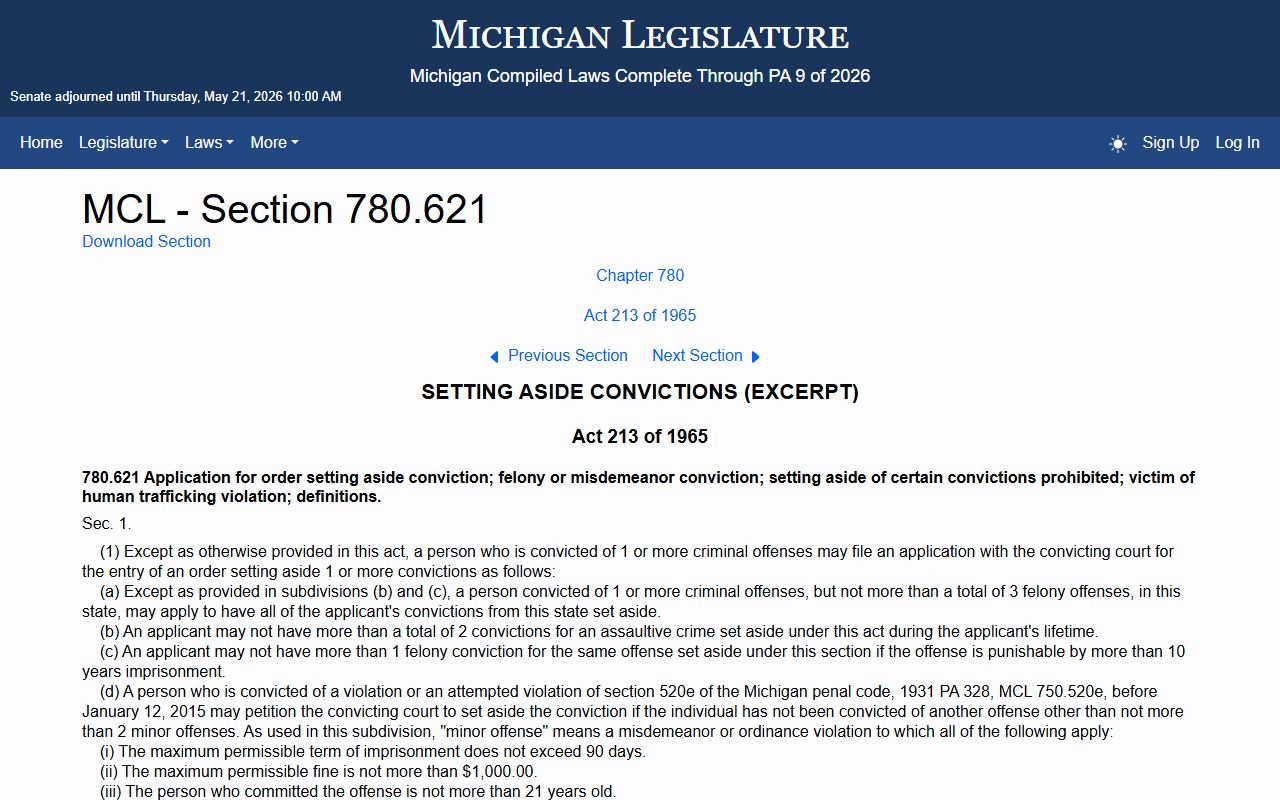
For sheriff or other county administrative records, send the FOIA request to the body that holds the record. For court files, follow the clerk of the court that owns the case.
Prosecutor and Indigent Defense Resources
Michigan counties use a Prosecuting Attorney, not a District Attorney. The Kalamazoo County Prosecutor handles criminal prosecution for cases filed in Kalamazoo courts. The office handles juvenile delinquency and protective matters as authorized, victim services, restitution information, and victim-impact statement opportunities. The Prosecutor is separate from the court clerk and cannot give legal advice to defendants. A defendant or family member with a question about a pending case usually contacts defense counsel first, not the prosecutor.
For indigent defense, the Kalamazoo County Office of the Public Advocate is the local access point. A defendant who cannot afford counsel requests court-appointed representation through the court process. Eligibility depends on financial information and case type. Public defense is not the same as civil legal aid; civil matters route through Legal Services of South Central Michigan or other civil providers. Victims and families who want custody-status alerts can use VINELink Michigan where the agency participates, since the Kalamazoo Sheriff feeds custody data into systems that can notify on release.