
How to Search Kalamazoo County Probate Records
The main route to Kalamazoo probate files runs through Michigan's statewide case lookup. The MiCOURT Probate route (P39) is the direct link to the Kalamazoo County Probate Court. That route filters out other courts and other counties before the first keystroke. Use it when you know the matter is a probate case. If you are not sure, the general MiCOURT Case Search portal lets you switch routes.
Before you open the portal, gather what you know. A case number is best. A clean last name comes next. The decedent or ward name is often the right search term, not the petitioner. Birth year narrows common names. Filed-date and case-year fields help with older files.
The screenshot below points to the official Probate Court building page, which is the right reference for the court's contact and workflow.
Kalamazoo County Probate Court page serves as the source.
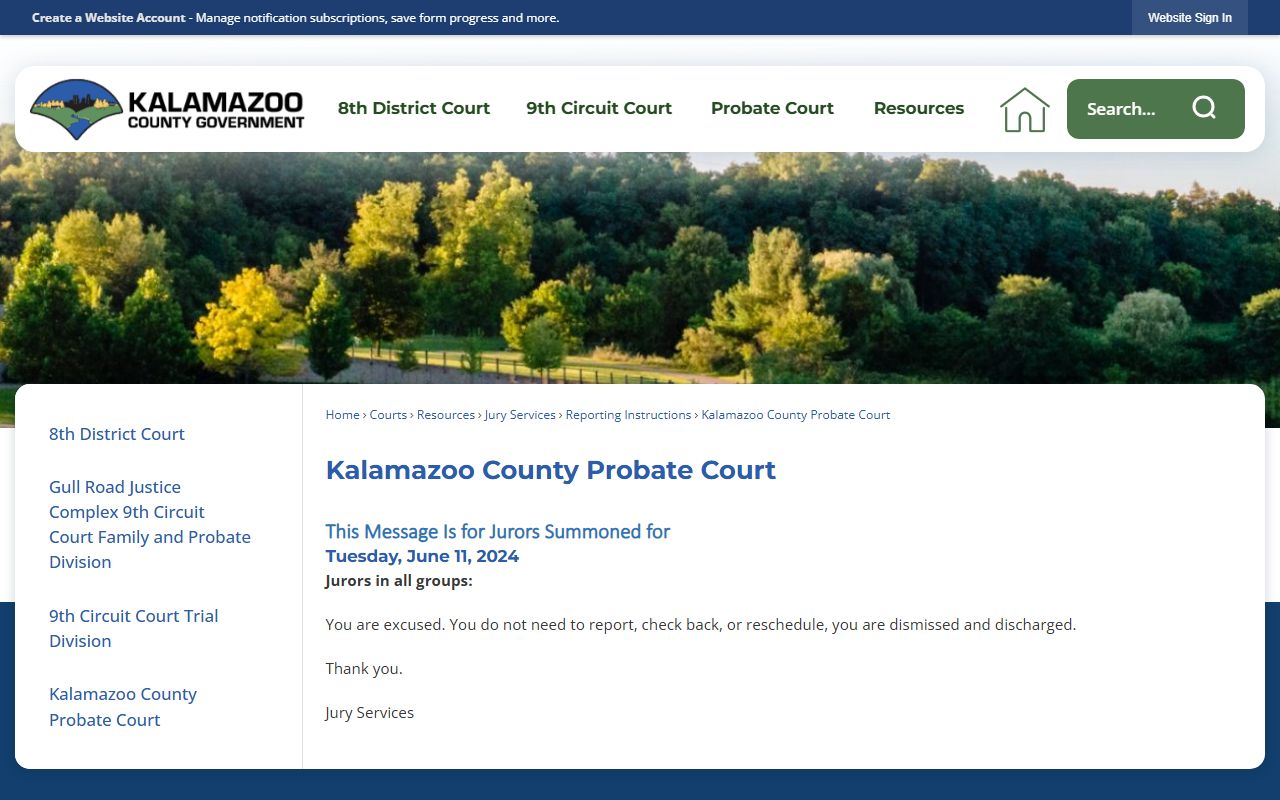
That page is the live source for the Probate Court contact route. After you confirm the right court, follow the steps below to run the search.
- Open the MiCOURT Probate route at the P39 link to land directly on Kalamazoo County Probate Court.
- Type the decedent, ward, or protected person's last name. Add a first name only if the last name is common.
- Paste the case number if a notice, letters of authority, or prior docket gave you one.
- Add a case year, case type, or filed-date range when the first search returns too many hits.
- Open a result to view the case header, parties, hearings, inventory data, and qualification status.
- Switch routes if no result appears. A divorce or family file sits in the 9th Circuit Court route, not the probate route.
- Request a clerk copy from the Probate Court when a certified document or a sealed view is needed.
The portal uses hCaptcha. Most public probate views run without a login. Some advanced views may push the user to a Michigan judiciary identity service.
What the Kalamazoo County Probate Court Handles
The Kalamazoo County Probate Court is the proper venue for any matter that involves a person's estate, a person's legal capacity, or a trust subject to court oversight. The general jurisdiction rule comes from MCL 600.861. Probate work does not move through the 8th District Court or the 9th Circuit Court, even when the same family has open cases in those other courts.
The screenshot below shows the official Michigan statute page for probate-court jurisdiction.
Source: MCL 600.861.
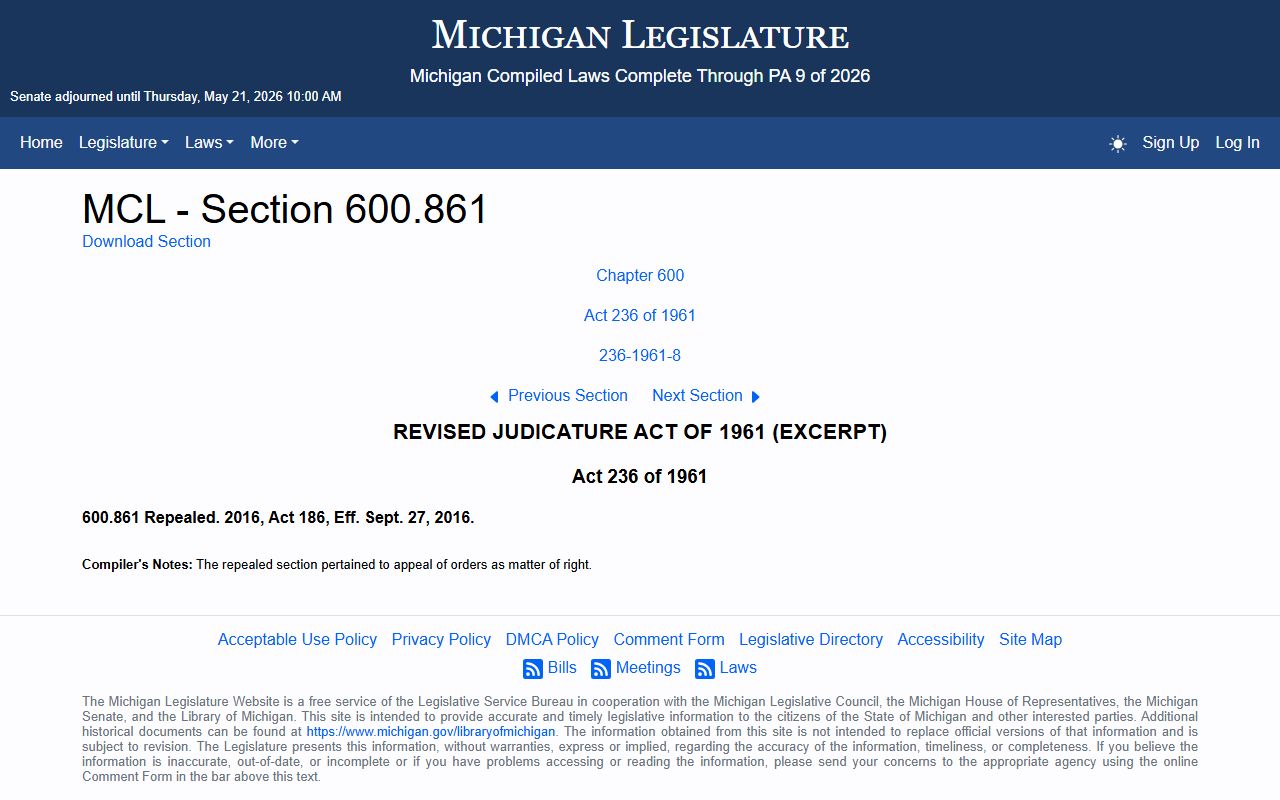
That statute is the legal base for the court's authority. Below it sit the case types that show up in the court's docket day after day.
Probate work covers decedent estates, wills, trusts, guardianships for minors and adults, conservatorships, protective proceedings, and mental-health proceedings. The county's Probate Court page lists the office, the workflow, and contact paths. The Kalamazoo County Probate Court building page covers the facility itself.
Types of Probate Cases
Probate is not one case type. It is a family of related case types. Each one uses its own SCAO form set. Each one moves through its own clerk workflow. The list below sums up the main categories handled in Kalamazoo County.
- Decedent estates. A case opened to administer the property of a person who has died. The court appoints a personal representative, oversees inventories, and approves final distribution.
- Formal versus informal probate. Informal probate runs through the probate register without a full court hearing in most steps. Formal probate runs through the judge and is used when a will is contested, when heirs disagree, or when complex issues need a court order.
- Guardianships for minors. A case to appoint a legal guardian for a child when a parent is unable to serve. The court reviews placement and may order ongoing reports.
- Guardianships for adults. A case to appoint a guardian for an adult who cannot meet basic needs due to mental or physical limits. The court holds review hearings to keep the order proper over time.
- Conservatorships. A case to appoint a conservator to manage money or property for a person who cannot. A guardian is not always also a conservator; the two roles are split when only one is needed.
- Trusts under court supervision. A case where a trust is filed with the court for oversight, accounting review, or a dispute among beneficiaries.
- Protective proceedings. A broader set of cases where the court issues orders to protect a person's safety, finances, or legal rights.
- Mental-health probate. A case under Michigan mental-health law that may involve hospitalization orders or alternative treatment. These files contain medical detail and stay restricted under state law.
Not every probate case ends in a long hearing schedule. Some run for months. Some run for years. The court adjusts review timing to the case type and the order in place.
Probate Record Fields
A Kalamazoo probate case detail screen displays a set of standard fields. The list below maps the field names from the MiCOURT probate route to plain English. Field display may vary by case status and case type.
| Field | What It Shows |
|---|---|
| Case Number | The court's unique ID for the file. Use this for any clerk request. |
| Decedent or Ward Name | The deceased person, minor, or protected adult at the center of the case. |
| Petitioner / Fiduciary | The person who filed or the person appointed to serve as personal representative, guardian, or conservator. |
| Probate Status | The current state of the case, such as open, closed, or supervised. |
| Inventory Amount | The total value of estate or protected-person assets reported on the inventory. |
| Inventory Date | The date the inventory was filed with the court. |
| Qualification Document | The filed document that confirms the fiduciary has accepted the role and met any bond rules. |
| Qualification Date | The date the fiduciary qualified to act under the court order. |
| Guardianship Review Due Date | The date the next required review is due in a guardianship case. |
| Hearings | Past and future hearing dates, types, and judges as set by the court. |
| Accountings | Periodic accountings filed by the fiduciary that detail receipts, disbursements, and remaining assets. |
Not every field is filled on every case. A small estate may show no inventory amount. A guardianship for a minor may show no qualification document until the order is entered.
Probate Filing Process
A Kalamazoo probate filing moves through a known set of steps. The exact route depends on the case type. The general workflow is the same.
- Decide what type of case fits the facts: decedent estate, guardianship, conservatorship, trust, or mental-health matter.
- Pick the right Michigan SCAO form. The SCAO forms library holds the official probate set.
- File the petition or application with the Kalamazoo County Probate Court. Pay the filing fee or ask the clerk about a fee waiver.
- Serve interested persons. Publish notice when the statute or a court order requires it.
- Attend any required hearing. Some uncontested matters move forward without a court appearance.
- Receive the order. If the petition is approved, the court issues letters of authority for the personal representative, guardian, or conservator.
- File the inventory and any periodic accountings on the schedule set by the court or the statute.
- Close the estate or continue scheduled guardianship and conservatorship reviews until the court terminates the case.
Self-help support is available. The Michigan Legal Help site has free probate guides and basic do-it-yourself form workflows. Complex cases should still use an attorney.
Note: Always confirm the current SCAO form version with the Probate Court before filing. Form versions change, and an old form can be rejected at intake.
Fee Schedule for Kalamazoo Probate
Probate fees in Kalamazoo County follow the state and county schedule. Specific dollar amounts are not posted on the captured official source pages used for this research pass. Verify all amounts with the Probate Court before sending payment.
| Item | Amount / Rule |
|---|---|
| Probate filing fees (petition or application) | Verify on the official Probate Court page or by calling the court. |
| Certified copies and letters of authority | Per copy fee; verify on the official Probate Court page or by calling the court. |
| Will deposit or safekeeping | Availability and any fee not located in the captured official source; verify with the Probate Court. |
| Inventory fee on estate value | Set by Michigan statute and based on inventory amount; verify the current schedule with the court. |
| Fee waiver for indigent applicants | SCAO fee-waiver process may apply. Ask the clerk for the current form. |
Pay only the amount the court confirms. Do not rely on a third-party site for current probate fees.
Restricted Probate Records
Not every probate file is open to the public. Michigan law and court rule block public access to several categories of probate data. The general probate jurisdiction statute at MCL 600.861 sets the court's authority. Public-access limits sit in other statutes and in court rules. MCL 710.67 protects adoption records. Court access rules sit in MCR 8.119, the Michigan Court Rule that governs case files and case-access standards.
Three groups of probate data carry strong restrictions:
- Mental-health proceedings. Hospitalization, assisted treatment, and related orders contain medical detail that stays off public view by law.
- Guardianship and conservatorship sensitive details. The case header may show, but personal medical reports, financial inventories of the protected person, and physician statements are often non-public.
- Juvenile probate matters. Some minor guardianships and protective-proceeding files stay restricted to protect the child.
To view a restricted probate file, a person must usually be a party, an attorney of record, a court-appointed fiduciary, or authorized by court order. A petition to open or modify access is filed in the Probate Court.
Probate Terms Glossary
Probate filings use a set of legal terms that show up over and over. The short list below covers the words a Kalamazoo probate user is most likely to see.
- Testator
- The person who makes a will. A testator must sign and witness the will under state rules.
- Executor
- The person named in a will to carry out its terms. Michigan often uses the broader term personal representative instead.
- Personal Representative
- The person appointed by the Probate Court to administer a decedent estate, whether named in a will or appointed when no will exists.
- Intestate
- Dying without a valid will. State law sets who inherits and in what share when a person dies intestate.
- Guardian
- A court-appointed person who makes personal-care decisions for a minor or protected adult.
- Conservator
- A court-appointed person who manages money or property for a minor or protected adult who cannot manage their own assets.
- Letters of Authority
- The court document that proves a personal representative, guardian, or conservator has the legal power to act in the role.
- Fiduciary
- A general term for any person who owes a legal duty of care and loyalty to another, such as a personal representative, guardian, conservator, or trustee.
Probate Court Contact and Location
The Kalamazoo County Probate Court is a separate facility in the county's court system. Confirm the address on the official Kalamazoo County Probate Court building page before traveling, because facility detail can change. The Probate Court page is the live source for office hours, judge information, and current contact paths.
Kalamazoo County Probate Court
Probate Court facility, Gull Road area complex
Kalamazoo, MI 49048
Confirm the exact street address from the official Probate Court page on the day of your visit. Bring your case paperwork and a government photo ID. Expect courthouse screening at entry.