
Overview of the 8th District Court
The 8th District Court sits at the bottom of Michigan's general trial-court structure. It is the busy front door for Kalamazoo County. Most local cases start here. The court hears misdemeanors. It hears civil infractions. It hears small claims. It also hears the early stages of felony cases. That early-stage role is important. A felony is filed and arraigned in the District Court before it moves up to circuit.
The court's civil reach is set by state law. Under MCL 600.8301, the District Court has exclusive civil jurisdiction up to the statutory ceiling, with small claims handled in a simplified track. Landlord-tenant summary proceedings, land contract forfeitures, and general civil suits within the dollar limit all run through this court. Cases above the limit, or family-law matters, route to the 9th Circuit Court instead.
The court also runs a long list of public-facing services beyond hearings. Pay a fine. Deny a ticket. Ask for a record copy. Order a transcript. Join a Zoom hearing. The District Court site keeps a separate page for each of those tasks, which is why this court works like its own clerk in practice.
The official 8th District Court page is the main hub for those services. The screenshot below shows the courthouse landing.
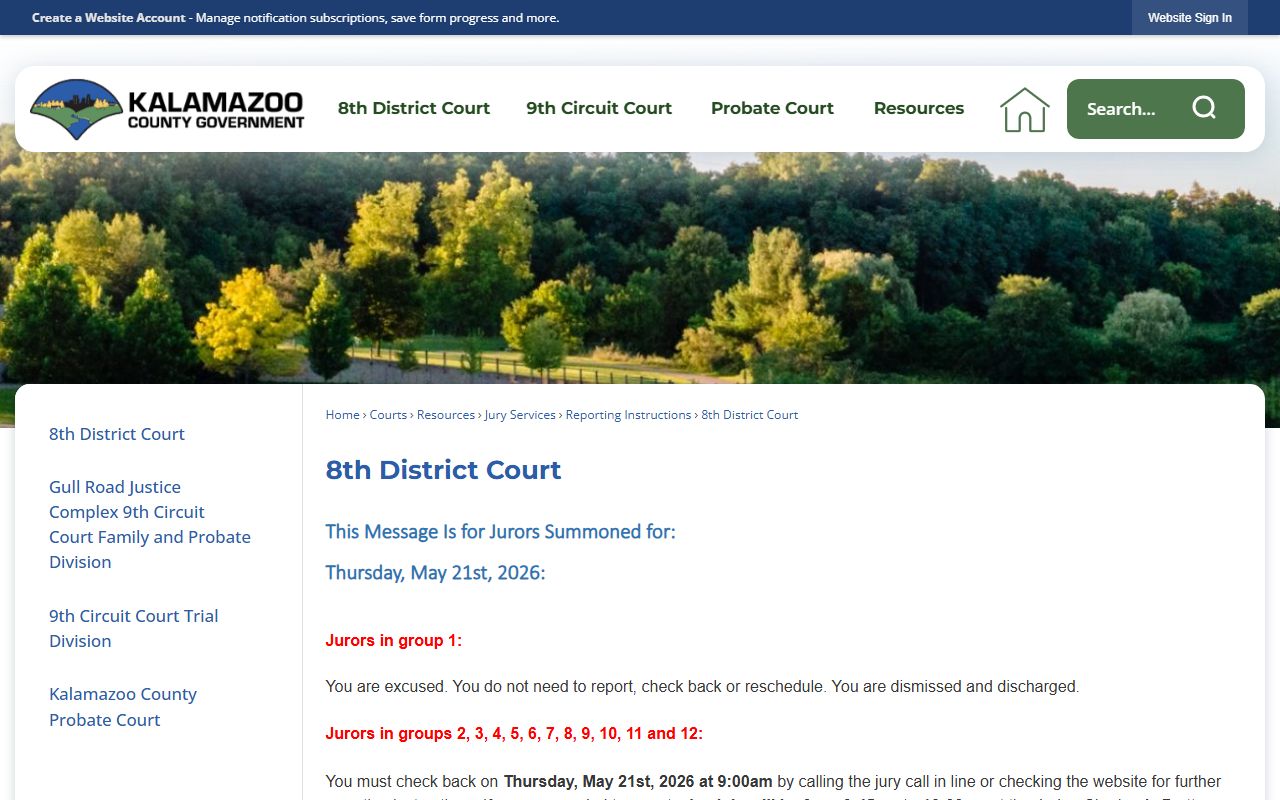
The courthouse address on West Michigan Avenue is the right starting point for in-person work at the District Court.
8th District Court Divisions
The District Court is broken into four working divisions. Each one has its own queue, its own staff, and its own forms.
Civil Division. This is where general civil lawsuits, landlord-tenant claims, small claims, and land contract forfeitures sit. The civil division also handles judgment work, garnishments, and post-judgment motions for cases within the District Court ceiling.
Criminal Division. Misdemeanors live here from start to finish. Felonies pass through for arraignment, bond review, a probable-cause conference, and a preliminary examination. After bindover, the felony moves to circuit. The criminal division also handles bench warrants, failure-to-appear, and post-sentence reviews on misdemeanor cases.
Traffic Division. Moving violations, non-moving violations, and most civil infractions belong to traffic. Three response paths exist for a ticket: admit responsibility and pay the fine, admit with explanation, or deny responsibility and ask for a hearing. The traffic division does not handle drunk-driving as a simple ticket; OWI is a criminal case.
Probation Department. Probation oversees defendants placed on supervision after a misdemeanor sentence or as a condition of bond. The department tracks reporting, tests, treatment compliance, and restitution.
The court's deep navigation also exposes sub-pages for judges and magistrates, days and hours, local administrative orders, parking, the virtual court portal, Zoom practice rules, legal document requests, the record-request workflow, the record-checks memorandum, transcript requests, and the fees and payments pair. That last pair matters because the District Court splits "fines and costs" from "payment information" across two separate official pages.
How to Search 8th District Court Records
Public case lookup for the 8th District Court runs through MiCOURT, Michigan's statewide case-search portal. The direct court route avoids hitting the wrong county or the wrong trial-court level. Use the D08 route for the 8th District Court.
The official MiCOURT entry points are MiCOURT Case Search and the direct D08 route for the 8th District Court. Open the D08 route first.
- Open the D08 route in MiCOURT before typing anything else.
- Pick party-name search if no case number is in hand. Type the last name first.
- Add first and middle name to narrow common surnames.
- Type the case number if a ticket, summons, or notice gives one. The exact format on the notice is the right format to use.
- Use case year if the case number begins with a year.
- Add a birth year to cut false matches on shared names.
- Filter by case type, case status, or case subcategory if too many results come back.
- Set a filed-date range or offense-date range to bound the search.
- Solve the hCaptcha challenge when prompted. Some advanced views may push to a Michigan judiciary login.
- Open a result to view the case header, parties, charges, events, hearings, bonds, financial orders, and sentencing data when public.
If no result appears, check court selection. A traffic ticket or misdemeanor should be in D08. A felony bound over to circuit may have only its early stages in D08 and the rest in C09. Sealed, juvenile, or set-aside cases may not appear in public search.
The Michigan SCAO forms library at courts.michigan.gov/SCAO-forms/district-court-index holds every official district-court form by category.
Filing Documents with the District Court Clerk
The 8th District Court Clerk handles filings for its own cases. That is separate from the County Clerk and Register of Deeds, which is the clerk of the 9th Circuit Court. The split matters. A traffic ticket, a small claim, a landlord-tenant complaint, or a misdemeanor filing goes to the District Court Clerk. A felony, divorce, or higher-value civil case goes to the County Clerk on the circuit side.
The District Court Clerk receives new complaints, petitions, motions, answers, and proofs of service. The clerk issues case numbers, schedules hearings, mails notices, and tracks payments. The clerk is also the office to call when a hearing date is missing from a notice, or when a docket entry looks wrong.
The official Record Requests page is the main hub for clerk paperwork beyond a new filing. The screenshot below shows the page layout.
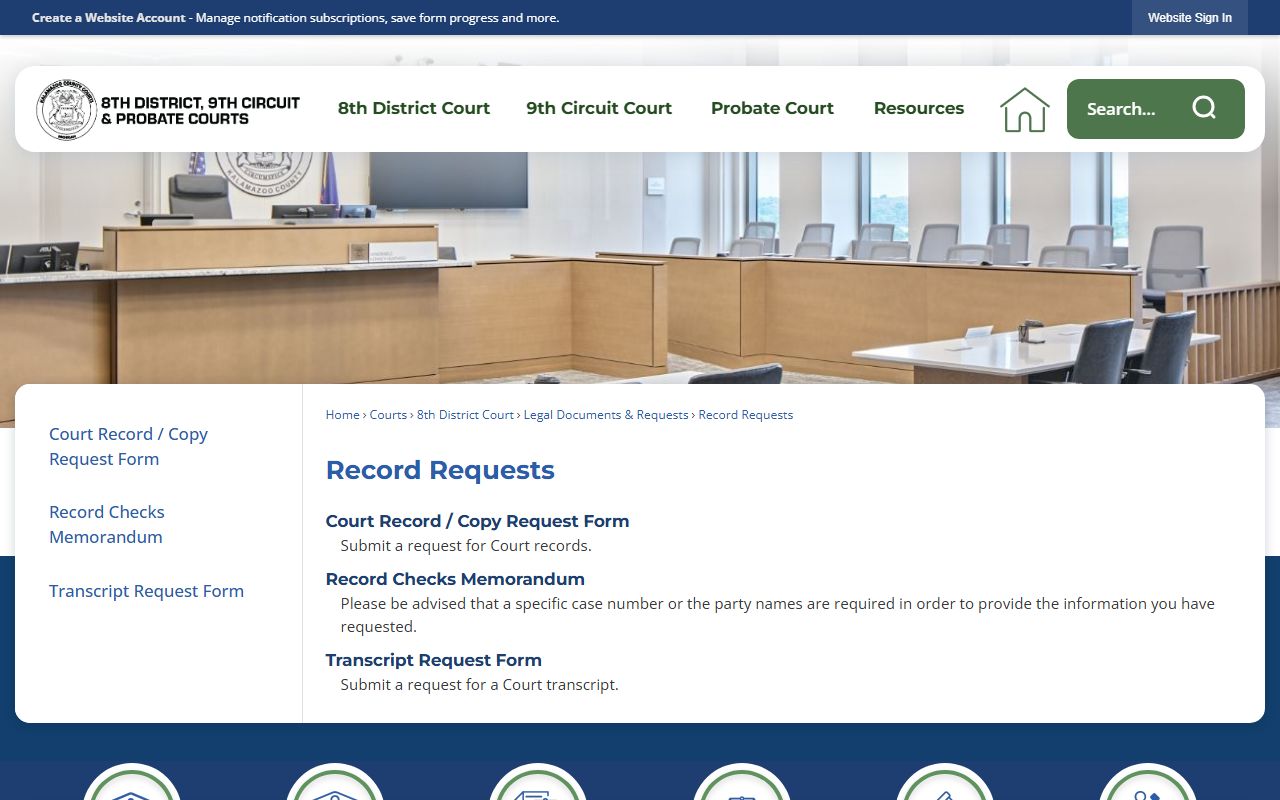
That page links the record-copy form, the transcript form, the record-checks memorandum, the fees page, and the payment page. Use it as the bookmark for any post-filing clerk task.
Note: Bring the case number to every clerk contact. The District Court Clerk works much faster with a clean case number than with a name alone.
Requesting District Court Record Copies
Copies of District Court files run through an online web form. The clerk pulls the file, makes the copy, and delivers by mail, pickup, or email if the form supports it. Certified copies require the same workflow because a certified copy must come from the court that holds the original.
The official form is the Court Record Copy Request Form. The screenshot below shows the live form.
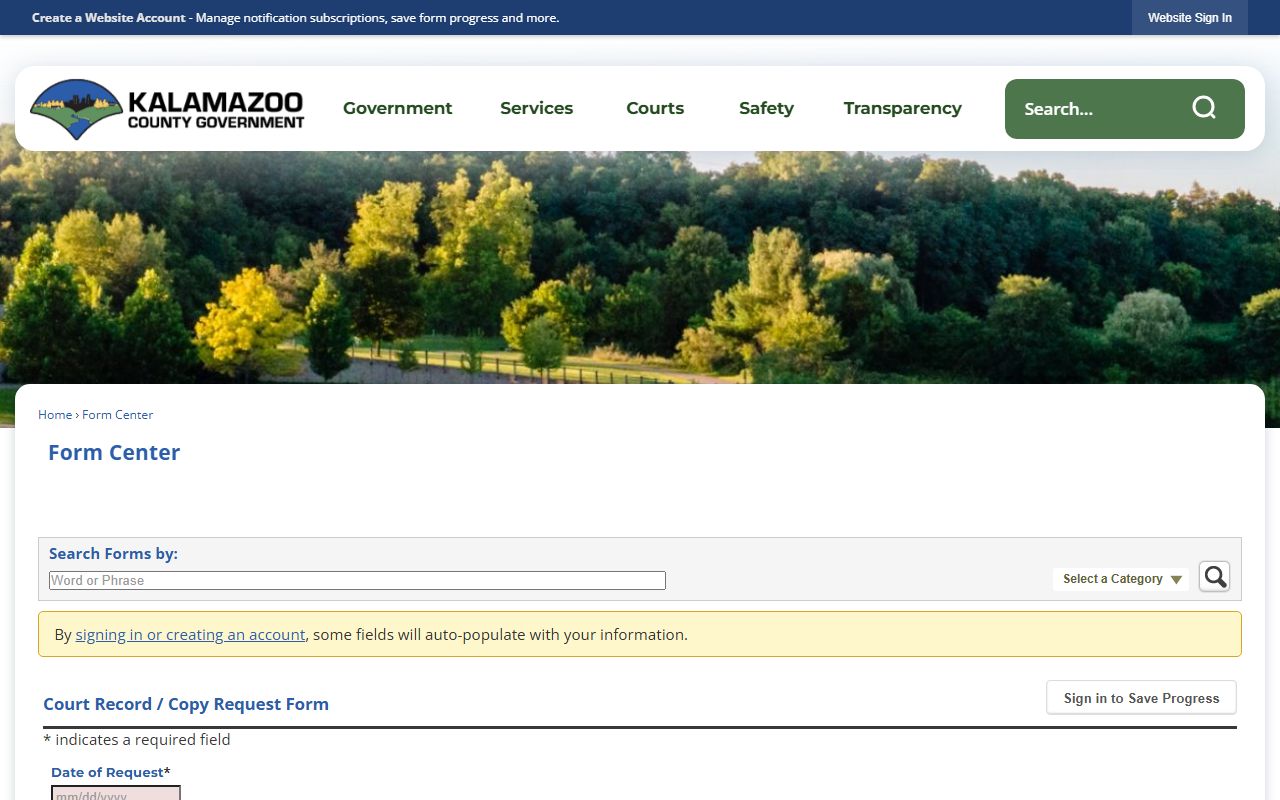
The form fields below are what users see in the live workflow.
| Field | Type | Notes |
|---|---|---|
| Requestor name | Text | Person asking for the copy. |
| Address / contact information | Text | Mailing or contact address for delivery. |
| Phone / email | Text / email | Used for follow-up on the request. |
| Case number | Text | Best single identifier; use the exact MiCOURT format. |
| Party name(s) | Text | Defendant, plaintiff, petitioner, or respondent. |
| Type of record requested | Checkbox / text | Plain copy, certified copy, or a specific document. |
| Delivery method | Choice / text | Mail, pickup, or email where offered. |
Step by step, the workflow runs like this.
- Open the official Court Record Copy Request Form on the county site.
- Type the requestor name and full mailing address.
- Add a phone number and an email so the clerk can ask follow-up questions.
- Type the District Court case number. Use the format from the notice or from MiCOURT.
- Add party names so the clerk can confirm the right file.
- Pick the type of record. Mark certified if a certified copy is needed.
- Pick the delivery method offered by the form.
- Submit the form and wait for the clerk to respond with cost and pickup or mailing instructions.
Sealed, juvenile, set-aside, and protected records may not be released through the public request workflow. Those need party status, attorney status, or a court order.
Requesting District Court Transcripts
A transcript is the written record of what was said at a hearing or trial. Transcripts are not the same as a record copy. A transcript is produced by a court reporter or court recorder from the official audio or stenographic record. Cost depends on length, scope, and turnaround.
The official form is the District Court Transcript Request Form. The screenshot below shows the live form.
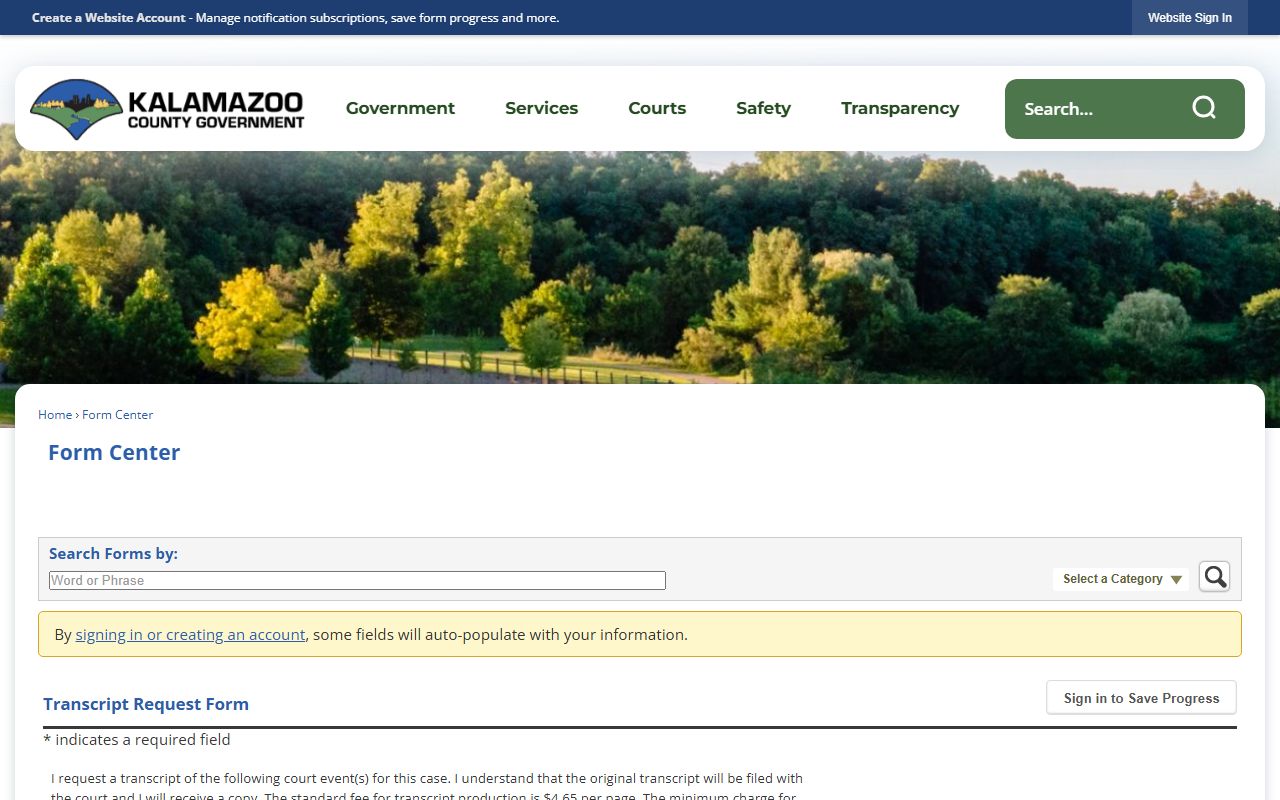
The fields below are what users fill out.
| Field | Type | Notes |
|---|---|---|
| Requestor name / contact | Text | Attorney, party, or other requester. |
| Case number | Text | District Court case number. |
| Case caption / party names | Text | Helps the court locate the proceeding. |
| Hearing date | Date | Required so the reporter can pull the right recording. |
| Judge / magistrate | Text or dropdown | Add if known. |
| Type of transcript | Checkbox / text | Full proceeding, selected hearing, or partial. |
| Payment / fee acknowledgement | Checkbox / text | Transcript fees depend on length and scope. |
Attorneys filing an appeal often need a certified transcript on a deadline. Pro se litigants on appeal may need the same. Start the transcript order early because a reporter cannot produce a long transcript overnight.
Fees and Payment
The District Court keeps two separate official pages for money. The Fines, Costs and Fees page lists charges tied to a case. The Payment Information page explains how to pay. The screenshot below shows the fines and costs page.
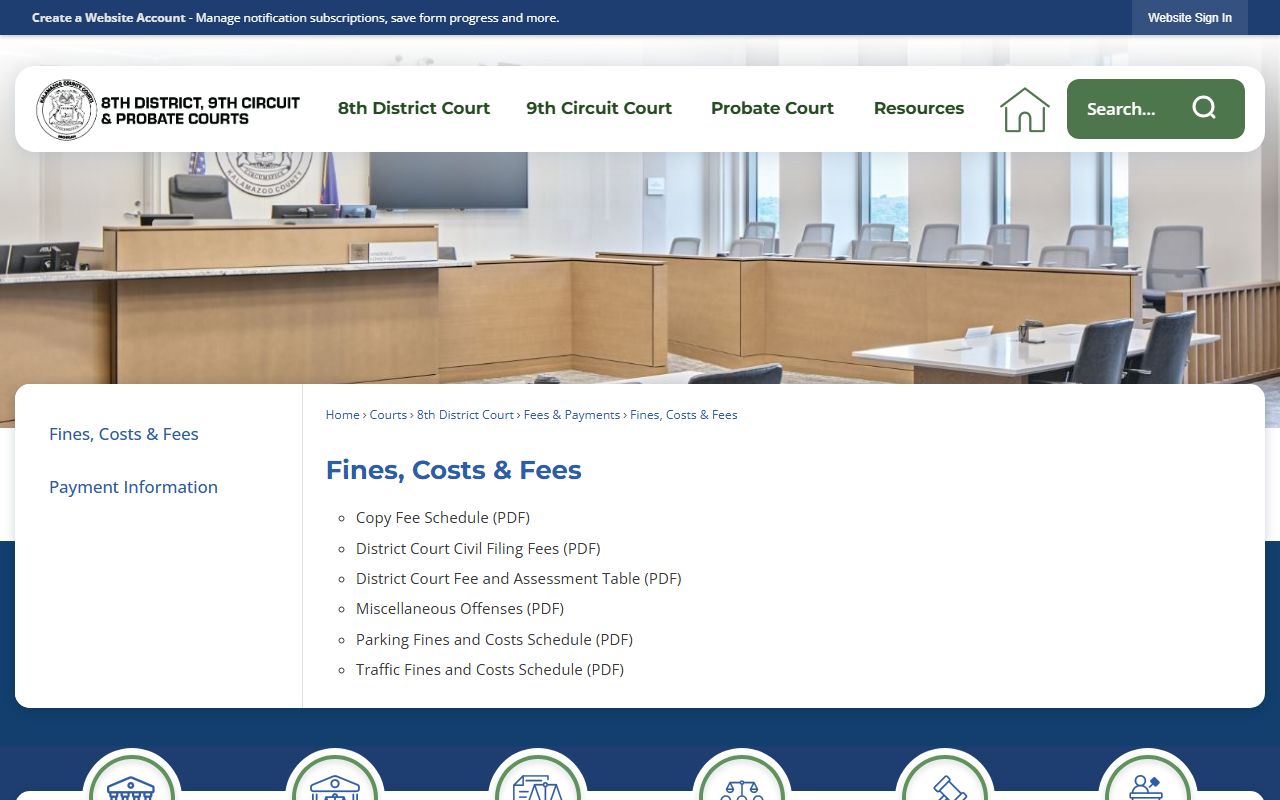
Specific dollar amounts change. The official site is the right place to confirm the current fee before sending a payment.
| Item | Amount | Source / note |
|---|---|---|
| District Court record copy | Verify on official page | Confirm on the Fines, Costs and Fees page before sending payment. |
| Certified copy | Verify on official page | Certified copies usually cost more than plain copies. |
| District Court transcript | Based on transcript scope | Cost depends on length of hearing and turnaround. |
| Traffic civil infraction fine | Set by violation | Listed on the citation or set after a deny-responsibility hearing. |
| Misdemeanor fines and costs | Set at sentencing | Court orders the total at the sentencing hearing. |
| Restitution | Set at sentencing | Paid to a victim through the court. |
| License clearance fee | Verify on official page | Paid when a license suspension is cleared after a missed appearance. |
Online payment options, mail-in payment, and in-person payment details all live on the payment information page. The screenshot below shows that page.
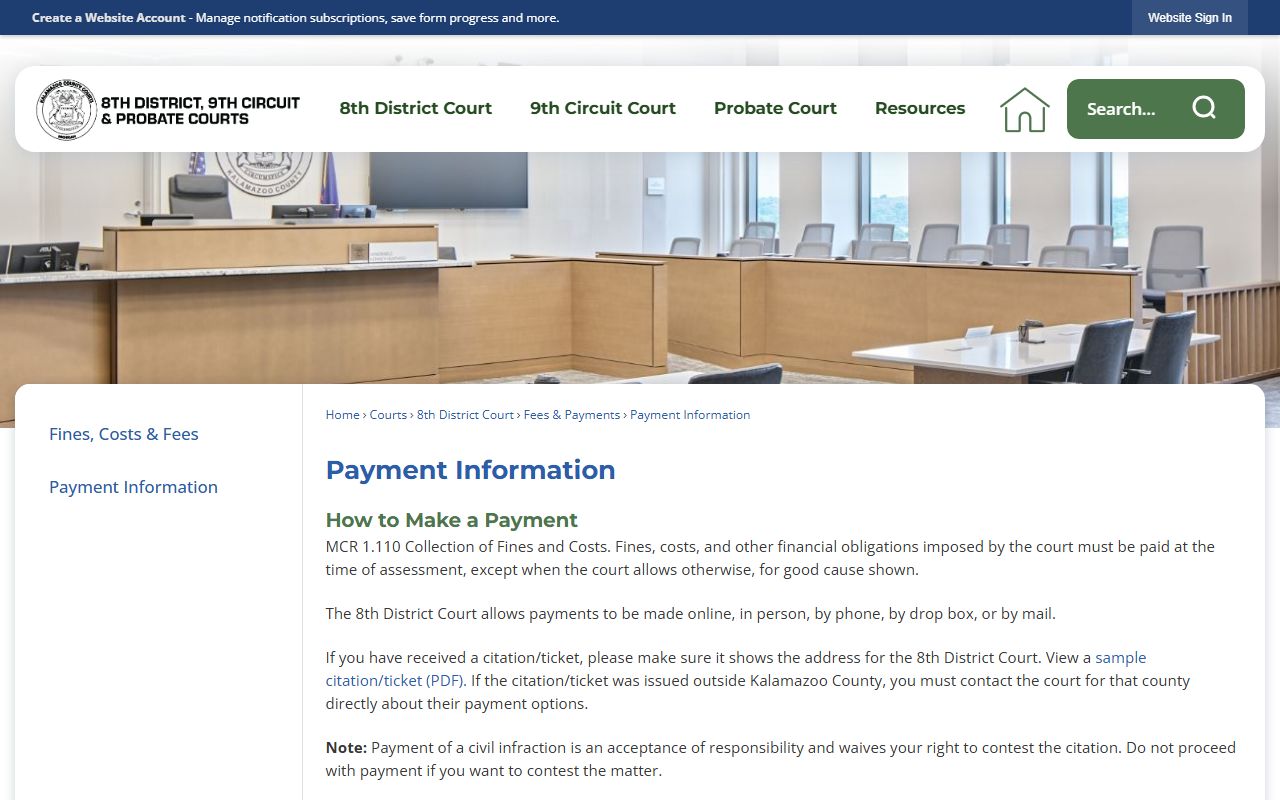
Always pay with the case number in hand. Posting a payment to the wrong case is a common cause of license-suspension headaches.
Traffic Division
The traffic division handles tickets. A driver who gets a citation in Kalamazoo County has three formal options.
Admit responsibility and pay the fine. This closes the case. It puts the violation on the driving record. Points may apply depending on the violation. Pay through the District Court payment page or by mail.
Admit responsibility with explanation. This is a written or in-person explanation to the court. A judge or magistrate may reduce the fine or costs after reviewing the explanation. The admission still goes on the record.
Deny responsibility. This sets a formal hearing. The officer who wrote the ticket usually testifies. The driver can present a defense, call witnesses, or hire a lawyer. If the court finds the driver responsible, the fine and costs are set after the hearing.
OWI and drunk-driving cases are not civil infractions. They are criminal cases and move through the criminal division with arraignment, bond, and possible jail or probation. Search the traffic court records page for more detail on the ticket workflow.
Civil and Small Claims
The civil division covers the smaller civil docket. Small claims is the most user-friendly track. A party files a sworn affidavit, pays a small filing fee, and asks the court to enter a judgment for a limited amount. No lawyers are needed. No jury is used.
Landlord-tenant cases run as summary proceedings. A landlord files a complaint to recover possession, rent, or both. The tenant gets a summons with a short answer window. A judgment can lead to a writ that lets the sheriff restore possession.
General civil suits within the district-court ceiling cover contract disputes, property damage claims, and consumer cases. Land contract forfeitures are filed when a buyer on a land contract has fallen behind on payments. Civil infractions outside of traffic, such as some local ordinance matters, also route through the civil division.
Probation Department and Sentencing
District Court probation supervises defendants placed on probation after a misdemeanor sentence. It also tracks defendants released on bond with conditions. The probation department runs reporting, drug or alcohol testing, treatment referrals, restitution collection, and compliance reports back to the judge.
Misdemeanor sentencing options include jail, probation, community service, fines, costs, restitution, and license consequences. A probation violation sends the defendant back to court for a violation hearing. A judge can extend supervision, add conditions, or impose a jail sentence on the underlying case.
Virtual Court Portal
The 8th District Court runs many hearings on Zoom. The Virtual Court Portal links the active Zoom rooms by judge or magistrate. Use the portal when a notice says the hearing is virtual or hybrid.
Best practice for a Zoom hearing is to join early, use a quiet space, mute the mic until spoken to, and have a paper copy of the notice and case number nearby. The court also publishes a Zoom Practice page with rules on dress, recording, and conduct in the virtual room. Recording a hearing without court permission is not allowed under Michigan court rules.
8th District Court Contact and Location
The District Court is downtown at the Kalamazoo County Courthouse. The official building information page is kalcounty.gov/8th-District-Court building page.
Kalamazoo County Courthouse / 8th District Court
227 West Michigan Avenue
Kalamazoo, MI 49007
The phone number for the District Court is not captured in the research notes used to build this page; the official building page has the current number. Parking changes day to day, so the Parking Information page is the right place to check before driving downtown. Expect courthouse screening at entry. Bring photo ID and the hearing notice.
Comparison: 8th District Court Clerk vs County Clerk
Kalamazoo County splits clerk duties between two offices. The 8th District Court Clerk runs the district court's filings, payments, and records. The County Clerk and Register of Deeds is the clerk of the 9th Circuit Court and handles vital records and land records. Pick the right office before mailing or driving.
| Function | 8th District Court Clerk | County Clerk / Register of Deeds |
|---|---|---|
| Court level | Limited-jurisdiction trial court | General-jurisdiction trial court |
| Misdemeanor filings | Yes | No |
| Traffic and civil infractions | Yes | No |
| Small claims | Yes | No |
| Landlord-tenant | Yes | No |
| Felony filings | Arraignment and preliminary stages only | Trial-level felony filings |
| Divorce and family | No | Yes, on the circuit side |
| Vital records (birth, death, marriage) | No | Yes |
| Register of Deeds (land records) | No | Yes |
| Record copies for its court | Yes, via the Court Record Copy form | Yes, for circuit cases and vital/land records |
| Transcripts | Yes, via the Transcript Request form | For circuit hearings |
| Payment of fines and costs | Yes, via the Payment Information page | For circuit-court financial orders |
The fastest way to know which office to use is to check the case type. Traffic, misdemeanor, small claims, or landlord-tenant points to the District Court Clerk. Felony, divorce, family, higher-value civil, marriage license, or land record points to the County Clerk.